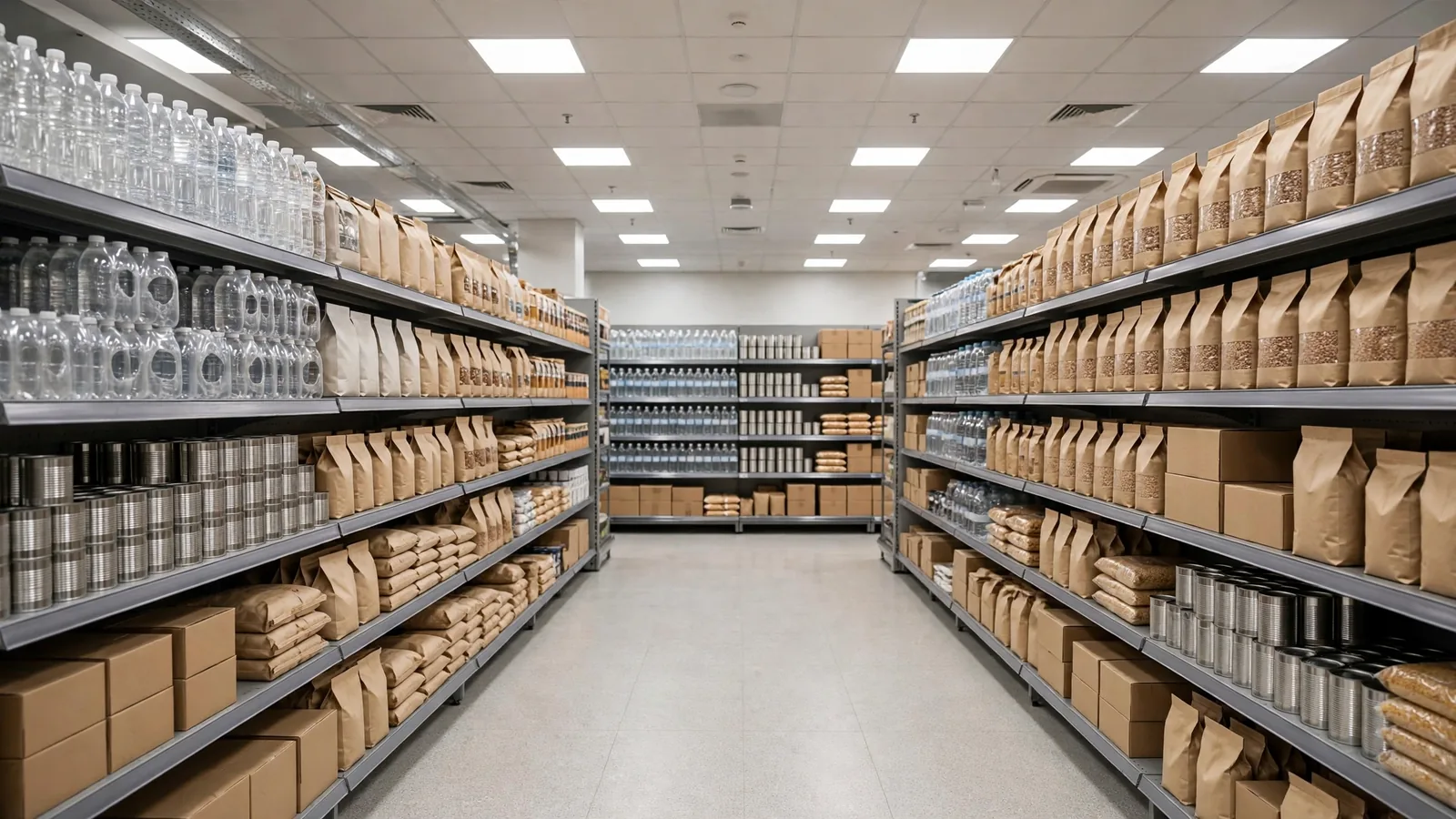
Noodwinkels: How the Emergency Supermarkets Would Work
A noodwinkel is not a new kind of shop. It is an ordinary supermarket, prepared in advance to keep selling food when the power, the internet and the card-payment system have all failed. The plan, reported by AD on 15 November 2026 and by Het Financieele Dagblad on 31 October 2026, would designate a portion of the Netherlands' roughly 4,500 supermarkets as emergency shops, so that every resident is within a 15-minute drive — or 30 minutes by bicycle — of one. This page explains how a noodwinkel is supposed to work, piece by piece, and what is still undecided.
In short
A noodwinkel (emergency shop) is an existing supermarket designated to keep operating in a crisis. According to reporting by AD via BeveiligingNieuws and AGF.nl on 15 November 2026, and by Het Financieele Dagblad via DutchBrief on 31 October 2026, designated stores would get backup generators (noodstroomaggregaten) — most Dutch supermarkets currently have none — and would sell essential foodstuffs only. The target is that every resident is within a 15-minute drive of a noodwinkel, or 30 minutes by bicycle, with more locations in densely populated areas and fewer in rural areas. The chains must also be able to supply each other analogously, without their usual, mutually incompatible computer systems. No new stores would be built. Which stores, which products, how storage works and who pays have not been decided; a final decision is expected before summer 2027.
The idea in one paragraph
The idea is simple to state and hard to build. The Netherlands has about 4,500 supermarkets, supplied by a just-in-time system that moves food from distribution centres to shelves in hours, ordered and paid for by computer. That system is efficient, and it is fragile: if the power fails, the tills, the lighting, the automatic doors, card payments and refrigeration all fail at once; if the computer systems fail, ordering and distribution stop even if the power is on. The Ahold Delhaize incident of October 2026 showed the second failure in real time — distribution centres stopped, shelves emptied, deliveries were suspended — and the refrigeration attacks showed the first. The noodwinkel plan is the sector's answer: pick a portion of the existing stores, give them generators, stock them with essentials, and make sure they can be supplied without computers, so that even in the worst case — fase zwart — people can still buy food within a short journey of home. No new stores would be built. The plan converts existing stores to emergency mode, which is cheaper and faster than building, and it uses the network that already exists: the shops people already walk to.
15 minutes by car, 30 minutes by bike
The most concrete number in the plan is the distance target. According to AGF.nl and BeveiligingNieuws, reporting the AD story on 15 November 2026, the target is that every resident should be within a 15-minute drive of a noodwinkel, and within 30 minutes by bicycle. More locations are planned in densely populated areas and fewer in rural areas, which is a recognition that a single national number of stores would leave the countryside uncovered and the cities oversupplied. The target matters because it defines what the plan is for: it is not about keeping every supermarket open, and it is not about a single national stockpile. It is about a network dense enough that nobody has to travel far for food in a crisis, including people without a car — hence the bicycle measure, which is a very Dutch way of setting a standard. How many stores that takes has not been decided, and the size of the regions each store would serve has not been decided either: the FD reporting of 31 October 2026 said region sizes were not yet decided, and the chains had been talking about the plan for about six months. Any number of noodwinkels published today would be a guess, and this site does not publish one. What can be said is that the target implies a substantial network — hundreds of stores, not dozens — because 15 minutes by car in a densely populated country still leaves a lot of ground to cover, and because a single store can only serve so many people when it is selling essentials to a whole neighbourhood at once.
Generators: the missing piece
The single most important piece of hardware in the plan is also the piece most stores do not have. Designated stores must get backup generators — noodstroomaggregaten — because most Dutch supermarkets currently have none. The point is easy to miss if you have never thought about what a supermarket needs in order to open. Without power, the tills do not work, so nothing can be sold. The lighting does not work, so the shop is dark. The automatic doors do not work, so customers cannot get in. Card payments (pinnen) do not work, so the only way to pay is cash — and the cash register needs power too. Refrigeration does not work, so fresh and frozen food spoils. A supermarket without power is not a shop with the lights off; it is a building that cannot function. Only a handful of Dutch supermarkets have an emergency generator today, according to the FD reporting of 31 October 2026, which quoted Ruud Limmen, chair of Albert Heijn's Incident Management Team. The average power cut in the Netherlands today lasts about 1.5 hours, Limmen said — short enough that a shop can simply wait it out. A fase zwart blackout would last days, and waiting it out is not an option. Generators also need regular maintenance, and CBL director Marc Jansen has said the cost is a central problem: "Het kost heel veel geld om dit allemaal te doen, voor alle zekerheid" — "It costs a lot of money to do all this, just in case." That cost, and who pays it, is one of the undecided questions, and it is why the chains are looking to the government for financial support.
Essential food only
A noodwinkel would not sell everything a normal supermarket sells. The assortment would be limited to essential foodstuffs only, according to the AD-derived reporting of 15 November 2026. What counts as essential has not been decided — that is one of the open questions, alongside how storage works and who pays — but the logic is clear. In a crisis, a shop needs to sell the food people need to survive for days: long-life staples, water, and the basics, not the full range. A limited assortment is also a logistical choice: fewer products means simpler ordering, simpler storage and simpler distribution, all of which matter when the computer systems are down and everything is being done by hand. One figure that sometimes appears in coverage — that a normal Dutch supermarket stocks about 25,000 products — comes from a single secondary source, a Turkish-language summary of 15 November 2026, and has not been verified against a Dutch source, so this site does not use it as a fact. What is verified is the principle: a noodwinkel is a narrowed shop, not a full shop with a generator. Readers should also note what that implies for shopping in a crisis: the noodwinkel is a place to buy essentials, not to do a normal weekly shop, and the government's household advice — 72 hours of food and water at home, in the Denk vooruit noodpakket — is designed to sit alongside it, not to be replaced by it.
Analogue supply: rivals sharing trucks
The most unusual part of the plan is also the least visible. The chains must be able to supply each other analogously — without their usual, mutually incompatible computer systems. That sentence, reported by BeveiligingNieuws and AGF.nl on 15 November 2026, describes a problem most shoppers never see. Each supermarket chain runs its own ordering, stock and distribution software, and those systems do not talk to each other. In normal times that does not matter, because each chain supplies its own stores. In a crisis, it matters a great deal: if one chain's distribution centre is down and another's is working, the working one cannot simply supply the other's stores, because the systems, the product codes, the ordering routines and the paperwork do not match. The plan therefore requires an analogue fallback — paper ordering, phone calls, manual stock counts, shared trucks, agreed product lists — so that food can move between chains without computers. CBL director Marc Jansen has described the lesson in those terms: the chain needs an "option B" for more analogue food distribution, so it is not only dependent on digital systems. The concept is verified via the AD/CBL coverage. One related claim — that NOS reported on 16 October 2026 that the industry was examining alternative distribution methods that work without normal digital networks — was NOT found in any NOS-derived source in the research for this site, and is not attributed to NOS here. The analogue-supply idea stands on the AD/CBL reporting alone, and that is how this site presents it.
Which stores — and what is not decided
Two design choices are already reported. First, chosen stores should not be inside enclosed shopping centres, according to the FD reporting of 31 October 2026, because those close in a blackout — a store that cannot be reached or opened is no use as an emergency shop. Second, the network is meant to be denser in cities and sparser in the countryside, reflecting where people live. Everything else about the stores is undecided. Which stores, in which towns, will become noodwinkels: not decided, and no list exists. Which products must be stocked: not decided. How storage works — whether noodwinkels hold extra stock in advance, or are resupplied in a crisis: not decided. Who pays for the generators, the maintenance and the stock: not decided, and under discussion between CBL and the Ministry of Agriculture. When the stores will be ready: not decided, beyond the expectation of a final decision before summer 2027. Smaller retailers are working on their own track: independent retailers are preparing "noodscripts" (emergency scripts) with the ministries of Economic Affairs, Defence and the NCTV, for three scenarios — a large-scale power outage, a climate disaster and war — according to FAQTS on 15 November 2026, quoting Vakcentrum spokesperson Patricia Hoogstraaten, who noted that many small shops cannot afford generators. That is a single secondary summary, and this site marks it as such. The noodwinkel plan, in short, is a design with a distance target and a hardware requirement, awaiting the decisions that would turn it into a list of addresses.
Frequently asked questions
It means emergency shop: an existing supermarket designated to keep operating in a crisis, fitted with a backup generator and selling essential food only. The target is that every resident is within a 15-minute drive, or 30 minutes by bicycle, of one.
That has not been decided, as of 17 November 2026. The plan covers a portion of the Netherlands' roughly 4,500 supermarkets, but no number, and no list of stores or towns, exists yet. A final decision is expected before summer 2027.
No. The plan converts existing stores to emergency mode; no new stores would be built, according to the reporting of 15 November 2026.
Without power, a supermarket cannot function: tills, lighting, automatic doors, card payments and refrigeration all fail. Most Dutch supermarkets currently have no backup generator, and only a handful have one, according to the FD reporting of 31 October 2026.
Essential foodstuffs only. Which products count as essential has not been decided yet.
The chains must be able to supply each other analogously — by paper, phone and manual routines — without their usual, mutually incompatible computer systems. CBL director Marc Jansen has called this an 'option B' for more analogue food distribution.
No, according to the FD reporting of 31 October 2026: chosen stores should not be inside enclosed shopping centres, because those close in a blackout.
Not decided. Financing is one of the points CBL is discussing with the Ministry of Agriculture, and CBL director Marc Jansen has said the cost is very high and the chains look to the government for financial support.
Figures are given with their snapshot time and source. Developing items are marked as developing. Last checked Tuesday 17 November 2026, about 12:50 PKT.