Frequently Asked Questions: Phase Black, Cyberattacks and Emergency Kits
The stories on this site raise the same questions again and again: is a cyberattack coming, is war coming, do I need to stockpile, what is the 72-hour rule, and does the EU or NATO require me to prepare? This page answers them directly, with the source for each answer. Where the answer is no, it says no. Where the answer is not known, it says so and gives the date it was checked.
In short
No official source says a specific cyberattack, war or blackout is imminent. The Dutch government says the Netherlands is not at war, but it is not at peace either, and there is no emergency now. The EU's preparedness guidelines of 30 October 2026 are non-binding and do not require anyone to stockpile. NATO's resilience requirements of 15 September 2026 are state-level and never mention household kits or 72 hours. The 72-hour rule is the official advice in most countries: keep enough food, water and essentials to cope on your own for at least three days. Stockpiling gradually, as the guidance advises, is preparation; panic-buying is not. The most useful first step is three litres of water per person per day, long-life food, a torch, a battery radio and some cash.
Is a cyberattack coming?
No official source says a specific cyberattack is imminent on a specific date. That is the short answer, and it is the same answer the fact-check on our is-a-cyberattack-coming page gives in full. What is true is that cyberattacks are happening: the Ahold Delhaize incident of 11 October 2026, the supermarket freezer attacks of October and November 2026, the Polish power-grid wiper attack of 29–30 December 2025, and the attacks on water systems, hospitals, retailers and a dam covered in our global cyberattacks hub are all verified. What is not true is that any government has warned of a specific attack on a specific date. The Dutch government's line is that there is no emergency now. The UK Cabinet Office, speaking about the BBC's Black Sky report, said there was no specific threat. Japan's disaster minister said on 2 November 2026 that he had no specific information about a coming disaster. The distinction matters: attacks are a continuing risk, not a dated prediction, and preparedness guidance is written for the risk, not for a date.
Is war coming to the Netherlands?
No government or CBL source says war is imminent, and this site does not present the Phase Black plan as evidence that it is. The plan is explicitly precautionary and scenario-based: it covers war, a large-scale cyberattack and a nationwide power outage as three possible triggers, and the supermarket sector is preparing for the most extreme scenario, not predicting it. The Dutch government's own line, quoted in fact-checks of the 33-countries list, is that the Netherlands is not at war, but it is not at peace either, and there is no emergency now. The plan's own timetable shows it is not an emergency response: a final decision on the noodwinkels is not expected before summer 2027, and the government's National Crisis Plan for Food Security is due in the first quarter of 2027. If you see the plan described as proof that war is coming, that description is not supported by any source on this site. For the full argument, see our page on whether the Netherlands is preparing for war.
Do I need to stockpile food?
Official guidance says yes, gradually, and no, not by panic-buying. The advice in nearly every country is the same: keep enough food and water to cope on your own for at least 72 hours, build the stock up a little at a time, and rotate it so it stays fresh. The Netherlands' Denk vooruit campaign, the UK's Be Ready campaign, the EU's guidelines of 30 October 2026, and the guidance of Sweden, Norway, Finland, Denmark, Germany, France, Belgium, Luxembourg, Canada, Japan and the United States all say this in their own words. What none of them says is to empty the shelves today. Panic-buying is the opposite of what the guidance asks for: it empties shops for everyone else, and it leaves you with food you may not be able to store or cook. The practical version is simple: buy a little extra of the long-life food you already eat, keep three litres of water per person per day, and keep some cash. The detailed numbers are on our page on how much food and water to store.
What does the 72-hour rule mean?
The 72-hour rule is the official advice, in most countries, to keep enough food, water and essentials to cope on your own for at least three days without electricity, water or internet. The number comes from emergency planning: 72 hours is roughly how long it takes for organised help to reach everyone after a major disruption, and it is the period the Dutch Denk vooruit campaign, the UK Be Ready campaign and the EU's guidelines all use as their baseline. It is a floor, not a ceiling. Sweden, Norway and Estonia ask for a week; Germany recommends ideally 10 days; Austria advises 14 days; the United States' current Ready.gov page says several days rather than a fixed number; and Ireland's booklet gives no fixed number at all. The EU's guidelines of 30 October 2026 set at least 72 hours as a minimum baseline but prescribe no quantities, no single kit and no deadline. The rule is explained in full on our 72-hour rule page, including why some countries ask for more.
Am I legally required to stockpile under EU rules?
No. The European Commission's Guidelines on Population Preparedness, Communication C(2026) 8250 final, dated 30 October 2026 and presented on 3 November 2026, are non-binding. They are addressed to member states and civil-protection authorities, not directly to households. They set at least 72 hours of self-sufficiency as a minimum baseline, but they prescribe no quantities, no mandatory kit, no deadlines and no penalties. The earlier Preparedness Union Strategy of 26 March 2025 is also a strategy document, not a law. No EU document requires any household to stockpile anything. What the EU does is ask member states to promote preparedness, including preparedness education in schools, disability-inclusive planning and better risk communication, and it has proposed an annual EU Preparedness Day on 23 October from 2027, which needs a joint declaration and is not yet law. If you see a claim that Brussels has ordered citizens to stockpile, that claim is wrong.
Has NATO ordered households to stockpile?
No. NATO's Resilience Baseline Requirements, published on 15 September 2026, are state-level requirements: they set out what allied governments must have ready for peace, crisis and conflict, across seven areas — continuity of government, resilient energy, movement of people, resilient food and water, mass casualties and health crises, civil communications and transport. The NATO text never mentions household kits or 72 hours. The household campaigns that followed in the autumn of 2026 — in the UK, Belgium, Luxembourg, Japan and elsewhere — are national decisions, not a NATO household instruction. NATO's requirements are about what states must be able to do, including keeping food and water supplies resilient at the national level, which is requirement four of the seven. That is a different thing from telling a household what to put in a cupboard, and this site does not confuse the two. The seven requirements are explained in plain English on our NATO page.
How much water do I need per person?
Three litres per person per day is the most common official figure, used by the Netherlands, the United Kingdom, Sweden, Denmark, Poland, Estonia and Japan. But the number depends on what it counts. Germany says two litres a day — 1.5 litres to drink and 0.5 litres for cooking — for 10 days. The United States says one gallon, about 3.8 litres, a day for drinking and sanitation. Canada's printed guide says two litres a day while its current website says about four, because the website counts drinking, cooking and hygiene together. France's 72-hour kit contains six litres of bottled water per person in total, not per day. Austria's guide says at least 2.5 litres a day, while an Austrian example list gives 21 litres for 14 days, which is 1.5 litres a day — a discrepancy this site flags rather than resolving silently. For a family of four at three litres a day, the arithmetic is 36 litres for 72 hours and 84 litres for a week. All the numbers, with their sources, are on our page on how much food and water to store.
What goes into a 72-hour emergency kit?
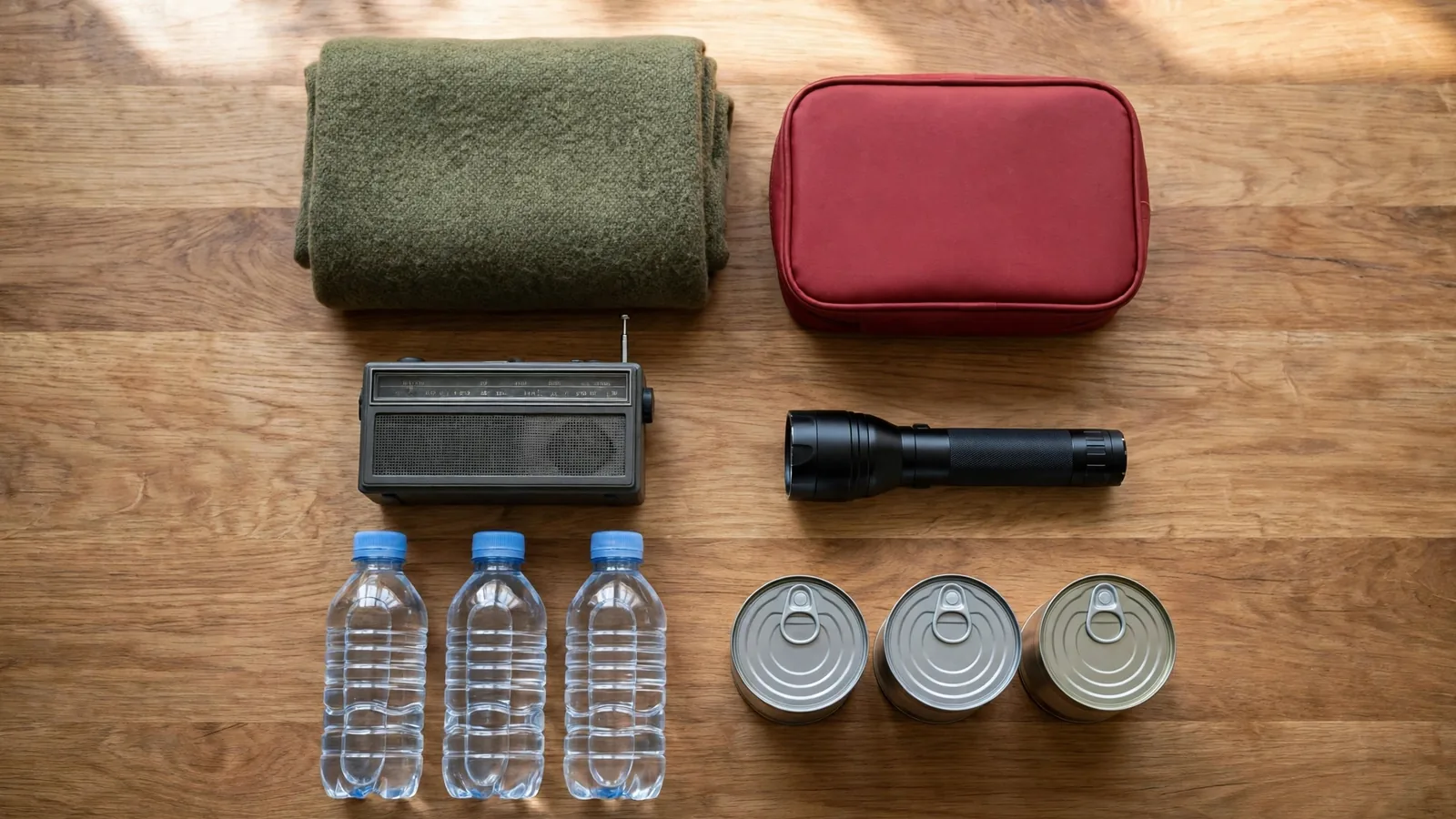
The lists differ by country, but the same items appear in nearly all of them. Water: three litres per person per day in most countries. Food: long-life food that needs no fridge and little or no cooking, for three days. Light and power: a torch with spare batteries and a charged power bank. Information: a battery or wind-up radio. Health: a first-aid kit and your regular medication. Money: cash in small notes and coins — the Netherlands advises about 70 euros per adult and 30 euros per child. Documents: copies of your identity documents. The Dutch Denk vooruit kit adds a blanket and advises checking the contents every six months. The UK Be Ready list adds baby and pet supplies where relevant. Sweden adds warm clothes and advises prescription medicines for about a month where possible. The printable checklist is on our emergency kit checklist page, and the Dutch kit item by item is on our Denk vooruit page.
What is fase zwart?
Fase zwart, or phase black, is the Dutch supermarket sector's term for the most extreme disruption level — beyond code rood, code red — in which normal food supply fails for a long period because of war, a major cyberattack, massive flooding or a prolonged nationwide power outage. CBL director Marc Jansen put it this way in reporting of 15 November 2026: up to code red we must be able to manage, but there is also code black. It is a scenario label used by the sector, not a term found in any published Dutch government emergency plan: no rijksoverheid or NCTV document using the term fase zwart was found in searches on 17 November 2026. The plan attached to it is the noodwinkel network — emergency supermarkets with generators and a limited range of essential food — and it is explained in full on our fase zwart page and our Netherlands hub.
Where can I get reliable information during a blackout?
From the radio and from official alerts, not from social media. A battery or wind-up radio is in nearly every official emergency kit, because radio keeps broadcasting when the internet and mobile networks do not. In the Netherlands, NL-Alert sends test messages twice a year, on the first Monday of June and December around noon, and the sirens are tested on the first Monday of every month at noon for one minute and 26 seconds; if you hear a siren at any other time, go inside, close windows and doors, and follow radio and television. In Norway, NRK P1 is the emergency channel; in Denmark, DR broadcasts emergency announcements on FM. In the United States, the Emergency Alert System broadcasts on radio and television — a nationwide test was held on 17 November 2026 at 2:20 p.m. ET. Official sources are your government, your grid operator and your local authority. Rumours travel faster than official information in a blackout, and acting on them makes the situation worse.
Frequently asked questions
No official source says a specific cyberattack is imminent on a specific date. Cyberattacks are a continuing risk — the Ahold Delhaize incident, the freezer attacks and the Polish grid attack are all verified — but no government has warned of a specific attack on a specific date.
No government or CBL source says war is imminent. The Phase Black plan is precautionary and scenario-based, and its own timetable — a final decision not expected before summer 2027 — shows it is not an emergency response. The government's line is that there is no emergency now.
Official guidance says to keep enough food and water for at least 72 hours, built up gradually and rotated so it stays fresh. It does not say to panic-buy. Panic-buying empties shelves for everyone else and is the opposite of what the guidance asks for.
The official advice, in most countries, to keep enough food, water and essentials to cope on your own for at least three days without electricity, water or internet. It is a floor, not a ceiling: Sweden, Norway and Estonia ask for a week, Germany recommends ideally 10 days, and Austria advises 14 days.
No. The EU's Guidelines on Population Preparedness of 30 October 2026 are non-binding, are addressed to member states rather than households, and prescribe no quantities, no mandatory kit, no deadlines and no penalties. No EU document requires any household to stockpile anything.
No. NATO's Resilience Baseline Requirements of 15 September 2026 are state-level requirements and never mention household kits or 72 hours. The household campaigns of autumn 2026 are national decisions, not a NATO household instruction.
Three litres per person per day is the most common figure, used by the Netherlands, the UK, Sweden, Denmark, Poland, Estonia and Japan. Germany says two litres, the US says one gallon (about 3.8 litres), and Canada's printed guide says two litres while its website says about four, because the website counts drinking, cooking and hygiene together.
Water, long-life food, a torch with spare batteries, a charged power bank, a battery or wind-up radio, a first-aid kit, regular medication, cash in small notes and coins, and copies of your identity documents. The Dutch guidance adds a blanket and advises checking the kit every six months.
The Dutch supermarket sector's term for the most extreme disruption scenario, beyond code red, in which normal food supply fails for a long period because of war, a major cyberattack, flooding or a prolonged nationwide blackout. It is a sector term, not a term in any published Dutch government emergency plan.
From a battery or wind-up radio and from official alerts such as NL-Alert in the Netherlands. Do not rely on social media: rumours travel faster than official information in a blackout, and acting on them makes the situation worse.
Figures are given with their snapshot time and source. Developing items are marked as developing. Last checked Tuesday 17 November 2026, about 12:50 PKT.