Denk Vooruit: The Dutch 72-Hour Emergency Kit (Noodpakket), Item by Item
Denk vooruit — "think ahead" — is the Dutch government's campaign to get households ready to cope for 72 hours without electricity, water or internet. At its heart is the noodpakket, the emergency kit: a list of items every household is advised to keep at home, from 3 litres of water per person per day to EUR 70 in cash per adult. This page gives the official list item by item, explains the campaign behind it, and reports how many Dutch people have actually made a kit.
In short
Denk vooruit is the Dutch government's multi-year preparedness campaign, launched 3 November 2025 at 09:00 and coordinated by the NCTV (National Coordinator for Counterterrorism and Security). It asks households to do three things: make a noodpakket (emergency kit), make a noodplan (emergency plan), and talk to each other and help each other — so they can cope for 72 hours without electricity, water or internet. The official noodpakket contents are: bottled water 3 litres per person per day (9 litres per person for 72 hours), long-life food, a torch plus batteries, a powerbank, a small first-aid kit, cash EUR 70 per adult and EUR 30 per child, a blanket, and a battery or wind-up radio; contents should be checked every 6 months. The booklet 'Bereid je voor op een noodsituatie' (Prepare for an emergency) was presented by Minister Van Oosten (Justice and Security) on 17 November 2025 at 18:30 and delivered to over 8.5 million households between 25 November 2025 and 10 January 2026. A new phase of the campaign, 'Wie doet wat?' (Who does what?), launched 12 October 2026. Uptake: 39% of Dutch people who read the booklet had assembled a noodpakket or started preparations (NCTV/Ipsos I&O flash survey, January 2026, n=2,111), and the share with a noodpakket rose from 30% in 2024 to 44% in 2026 (Rasch study), while the share with a noodplan doubled to 12%.
What Denk vooruit is
Denk vooruit — "think ahead" — is the Dutch government's multi-year preparedness campaign, launched on 3 November 2025 at 09:00 and coordinated by the NCTV, the National Coordinator for Counterterrorism and Security. It runs on television, radio and online, and it has a simple structure: three steps. Make a noodpakket — an emergency kit. Make a noodplan — an emergency plan for your household. And talk to each other and help each other — because preparedness is not only about what is in your cupboard, but about knowing who in your street needs help and who can give it. The goal is to be able to cope for 72 hours without electricity, water or internet. That 72-hour figure is the same figure as in the EU's Preparedness Union Strategy and the EU's guidance of 30 October 2026, and it is the figure that sits behind the whole Dutch preparedness debate — including the argument, covered on its own page, about whether 72 hours is enough or whether households should hold 8 days. Denk vooruit is the government's answer for households; the noodwinkel plan and the Landelijk Crisisplan Voedselzekerheid are the answers for the shops and the system. The campaign is not a response to a specific threat or a specific date: the government's line, quoted in fact-checks, is that the Netherlands is "not at war, but it is not at peace either" and that "there is no emergency now." The campaign is precautionary, in the same way as the fase zwart plan — preparation before it is needed, not a warning that it is needed tomorrow.
The booklet to 8.5 million households
The campaign's most visible act was a booklet. On 17 November 2025 at 18:30, Minister Van Oosten (Justice and Security) presented the booklet "Bereid je voor op een noodsituatie" — "Prepare for an emergency". It was delivered to over 8.5 million households between 25 November 2025 and 10 January 2026, according to rijksoverheid.nl — one of the largest single mailings in Dutch government history, reaching effectively every household in the country. The delivery window varies slightly by source — one summary says 25 November to 1 January, and the ministry's letter of June 2026 says 17 November to 18 December 2025 to over 8 million addresses — so this site uses the rijksoverheid figure as primary: over 8.5 million households, late November 2025 to January 2026. The booklet explains the three steps, lists the noodpakket contents, and tells households what to do in different emergencies. Its scale matters: a campaign that reaches every household is a campaign that sets the national baseline for preparedness, and the uptake figures that follow — 39% of readers making a kit, 44% of Dutch people now having one — are measured against that baseline. The booklet is also the reason the noodpakket list is so widely known in the Netherlands: it is not a list on a website, it is a physical object that arrived in the post.
The noodpakket, item by item
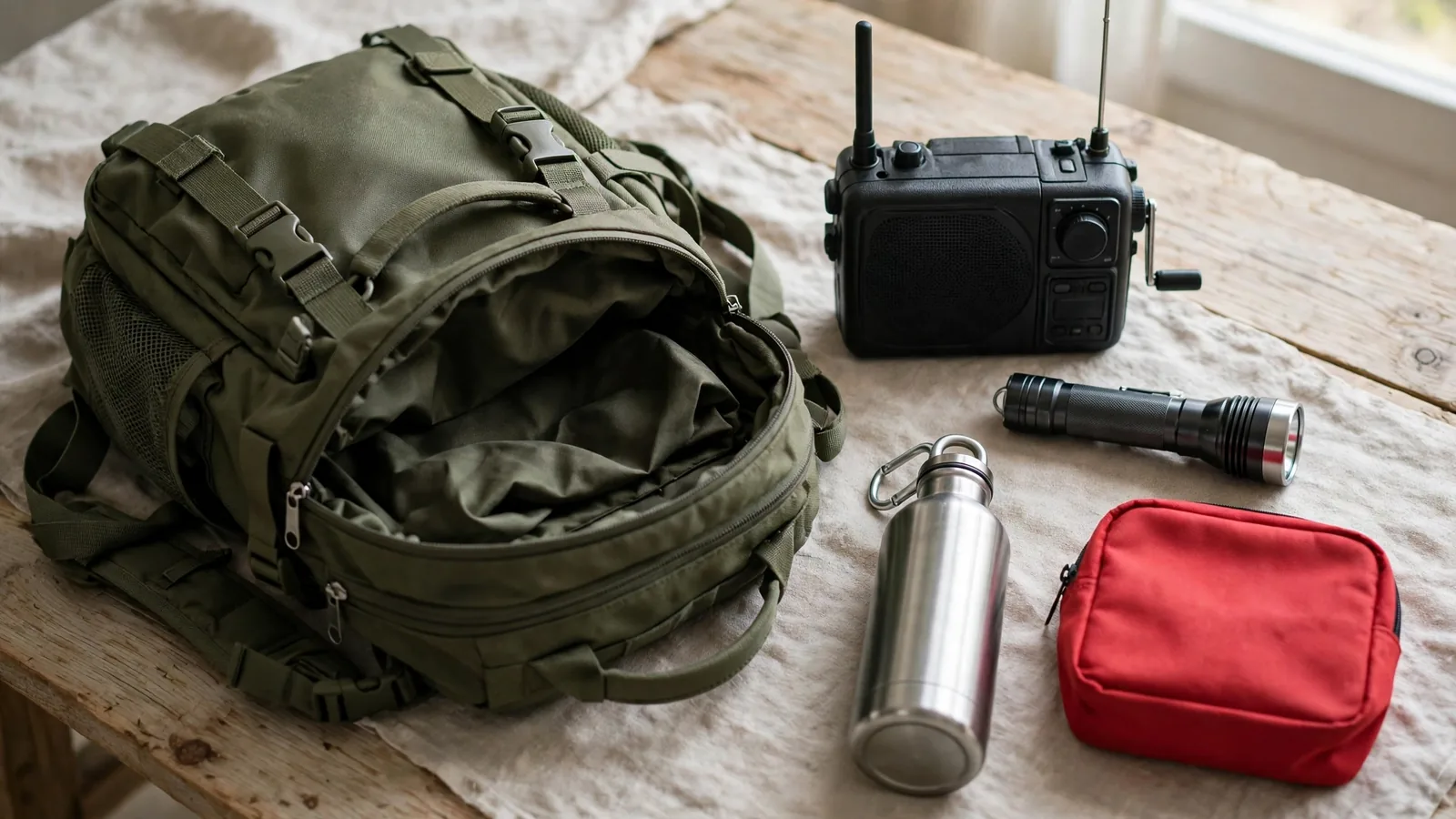
The official noodpakket contents, from rijksoverheid.nl, are as follows. Bottled water: 3 litres per person per day, which is 9 litres per person for 72 hours — the single most important item, because a person can survive longer without food than without water, and because the water supply is one of the systems that fails in a blackout. Long-life food: food that keeps without refrigeration and can be eaten without cooking, or with minimal preparation — tinned food, dried food, crackers, nuts, dried fruit. A torch, plus batteries: because the lights will be out, and a phone torch drains the phone's battery. A powerbank: to charge a phone, so it can receive NL-Alert messages and so the household can stay in contact. A small first-aid kit: plasters, bandages, disinfectant, and any personal medication. Cash: EUR 70 per adult and EUR 30 per child, in small notes and coins — because card payments (pinnen) fail without power and without internet, and a shop that cannot take cards can still take cash. A blanket: for warmth if the heating fails. A battery or wind-up radio: to receive official information when the internet and television are down — the radio is the fallback channel, and it is why the warning-systems page in this hub treats radio as essential. The contents should be checked every 6 months, according to the official guidance — water expires, batteries leak, food goes out of date, and a kit that is not maintained is a kit that fails when it is needed. Households should also keep the kit in a place that is easy to reach in the dark, and should know where it is without having to search for it.
The new phase: 'Wie doet wat?'
On 12 October 2026, a new phase of Denk vooruit launched, under the title "Wie doet wat?" — "Who does what?". The new phase is based on the NCTV's Risico- en Crisisbarometer (Risk and Crisis Barometer), which found that over half of Dutch people worry about the failure of vital processes — power, water, internet — and that over 4 in 10 had already done something to prepare. The question "who does what" is a shift in emphasis: the first phase of the campaign told households what to do; the new phase asks who does what in a crisis — what the government does, what the emergency services do, what the supermarkets do, and what households themselves must do. It is a recognition that preparedness is a shared responsibility, and that households need to know not only what is in their kit, but what to expect from others. The timing matters too: the new phase launched on 12 October 2026, the day after the Ahold Delhaize incident was detected and the day the refrigeration attacks hit France — the week the Dutch public was seeing, in real time, what a failure of vital processes looks like. The campaign's new phase was planned before those events, according to the reporting, but it landed in a week when its message was suddenly concrete.
How many people have actually made a kit?
The uptake figures are encouraging and incomplete, in equal measure. An NCTV/Ipsos I&O flash survey of January 2026, published in April 2026, with 2,111 respondents, found that 39% of Dutch people who read the booklet had assembled a noodpakket or started preparations. A separate Rasch study found that the share of Dutch people with a noodpakket rose from 30% in 2024 to 44% in 2026, and that the share with a noodplan — an emergency plan, not just a kit — doubled to 12%. The two figures measure different things — readers of the booklet, and the population as a whole — but they point the same way: a large minority of Dutch households now has a kit, and the number is rising, but a majority still does not, and the number with a plan is far lower than the number with a kit. That gap matters: a kit without a plan is a box of supplies with no idea of what to do with them — who to call, where to go, how to get information, who in the household does what. The campaign's three steps are designed to close that gap, and the new "Wie doet wat?" phase is explicitly about the plan, not just the kit. The figures also show the campaign is working, slowly: a rise from 30% to 44% in two years is a substantial change in national behaviour, and it happened before the fase zwart publicity of November 2026, which is likely to push the number higher still.
Denk vooruit and fase zwart: how they fit
Denk vooruit and fase zwart are often mentioned together, and they fit together as two halves of the same preparedness system. Denk vooruit is the household half: 72 hours of food and water at home, a plan, and neighbours who help each other. Fase zwart is the shop half: emergency supermarkets that keep selling essentials when the power and the computers fail. The government plan, the Landelijk Crisisplan Voedselzekerheid, is the system half: coordination, stockpiling and a cyber-incident playbook. The three are designed to work in sequence: the household kit covers the first 72 hours, the noodwinkels cover the period after that, and the government plan coordinates the whole. That is why the 72-hours-or-8-days argument matters: if the household kit runs out before the shops are back, the sequence breaks, and the gap is filled either by a longer household stockpile or by a bigger role for the shops. Readers who want the official list for their own household will find it above; readers who want to know what happens after 72 hours will find it on the noodwinkel and food-security pages. And readers who want the printable checklist for a 72-hour kit will find it in the preparedness hub.
Frequently asked questions
Denk vooruit ('Think ahead') is the Dutch government's multi-year preparedness campaign, launched 3 November 2025 and coordinated by the NCTV. It asks households to make a noodpakket (emergency kit), make a noodplan (emergency plan), and talk to each other and help each other, so they can cope for 72 hours without electricity, water or internet.
The official contents are: bottled water 3 litres per person per day (9 litres per person for 72 hours), long-life food, a torch plus batteries, a powerbank, a small first-aid kit, cash EUR 70 per adult and EUR 30 per child, a blanket, and a battery or wind-up radio. Check the contents every 6 months.
3 litres per person per day, according to the official Dutch guidance — 9 litres per person for 72 hours.
EUR 70 per adult and EUR 30 per child, in small notes and coins, according to the official guidance — because card payments fail without power and internet.
'Bereid je voor op een noodsituatie' (Prepare for an emergency), presented by Minister Van Oosten on 17 November 2025 and delivered to over 8.5 million households between late November 2025 and January 2026.
44% in 2026, up from 30% in 2024, according to a Rasch study. Among people who read the booklet, 39% had assembled a noodpakket or started preparations (NCTV/Ipsos I&O flash survey, January 2026, n=2,111).
The new phase of Denk vooruit, launched 12 October 2026, asking 'Who does what?' in a crisis — what the government, the emergency services, the supermarkets and households each do. It is based on the NCTV Risico- en Crisisbarometer.
Every 6 months, according to the official guidance — water expires, batteries leak and food goes out of date.
An emergency plan for your household: who to call, where to go, how to get information, and who does what. Only 12% of Dutch people had one in 2026, double the earlier figure, but far fewer than the 44% with a kit.
No. It is a precautionary campaign, and the government's line is that there is no emergency now. The campaign was launched in November 2025, a year before the fase zwart publicity.
Figures are given with their snapshot time and source. Developing items are marked as developing. Last checked Tuesday 17 November 2026, about 12:50 PKT.