Netherlands Phase Black (Fase Zwart): What We Know
Dutch supermarkets are preparing for an extreme scenario they call "fase zwart" — phase black — in which normal food supply fails for a prolonged period because of war, a large-scale cyberattack or a nationwide power outage. The plan, reported by the newspaper AD on 15 November 2026 and first reported by Het Financieele Dagblad on 31 October 2026, would turn a portion of the country's roughly 4,500 supermarkets into noodwinkels — emergency shops — so that every resident is within a 15-minute drive of one. This page is the hub for the story: what the plan is, what triggered it, what is decided and what is not.
In short
Fase zwart (phase black) is the Dutch supermarket sector's term for the most extreme disruption level — beyond "code rood" (code red) — in which normal food supply fails for a long period because of war, a major cyberattack or a prolonged nationwide power outage. The plan, reported by AD on 15 November 2026 and by Het Financieele Dagblad on 31 October 2026, would designate a portion of the Netherlands' roughly 4,500 supermarkets as noodwinkels (emergency shops), fitted with backup generators and stocked with essential food only, so every resident is within a 15-minute drive — or 30 minutes by bicycle — of one. It is a sector plan led by the supermarket trade association CBL, not a government programme, and much of it is undecided: which stores, which products, who pays, and when they will be ready. A final decision is expected before summer 2027. The trigger was two separate October 2026 events — the Ahold Delhaize cyber incident that emptied Albert Heijn shelves, and attacks on supermarket refrigeration systems abroad — which Dutch authorities say are not connected to each other.
What happened on 15 November 2026
On 15 November 2026, the Dutch newspaper AD reported that Dutch supermarkets are preparing for "fase zwart" — an extreme scenario in which normal food supply fails for a prolonged period because of war, a large-scale cyberattack or a nationwide power outage. The AD report was summarised the same day by several independent Dutch and trade outlets, including BeveiligingNieuws and AGF.nl, with mutually consistent details, and the AD article's URL slug was cited by an independent newsletter. AD's own text could not be read first-hand in the research for this site — the newspaper is paywalled and its site was blocked in the research session — so no AD wording is presented here as a verbatim quote. What is reported consistently is the shape of the plan: a portion of the roughly 4,500 supermarkets in the Netherlands would be designated as noodwinkels, or emergency shops. No new stores would be built. Existing stores would be converted to emergency mode, fitted with backup generators, and able to keep selling essential food when the power, the internet and the card-payment system have failed.
The story was not new on 15 November. Het Financieele Dagblad (FD) had first reported the emergency-shop plan on 31 October 2026, describing chains that want at least one supermarket per region to stay open during a long power cut. The FD reporting, summarised by DutchBrief on 31 October, also carried the first details that have since been repeated: the average power cut in the Netherlands today lasts about 1.5 hours, according to Ruud Limmen, chair of Albert Heijn's Incident Management Team, and only a handful of Dutch supermarkets have an emergency generator. The chains have been talking about the plan for about half a year — roughly six months — with CBL and the Ministry of Agriculture, according to a summary of the FD reporting. The AD report of 15 November turned a trade-press story into national news, and it did so days after two separate cyber incidents had shown, in quick succession, how fast a modern food chain can break.
What a noodwinkel is supposed to be
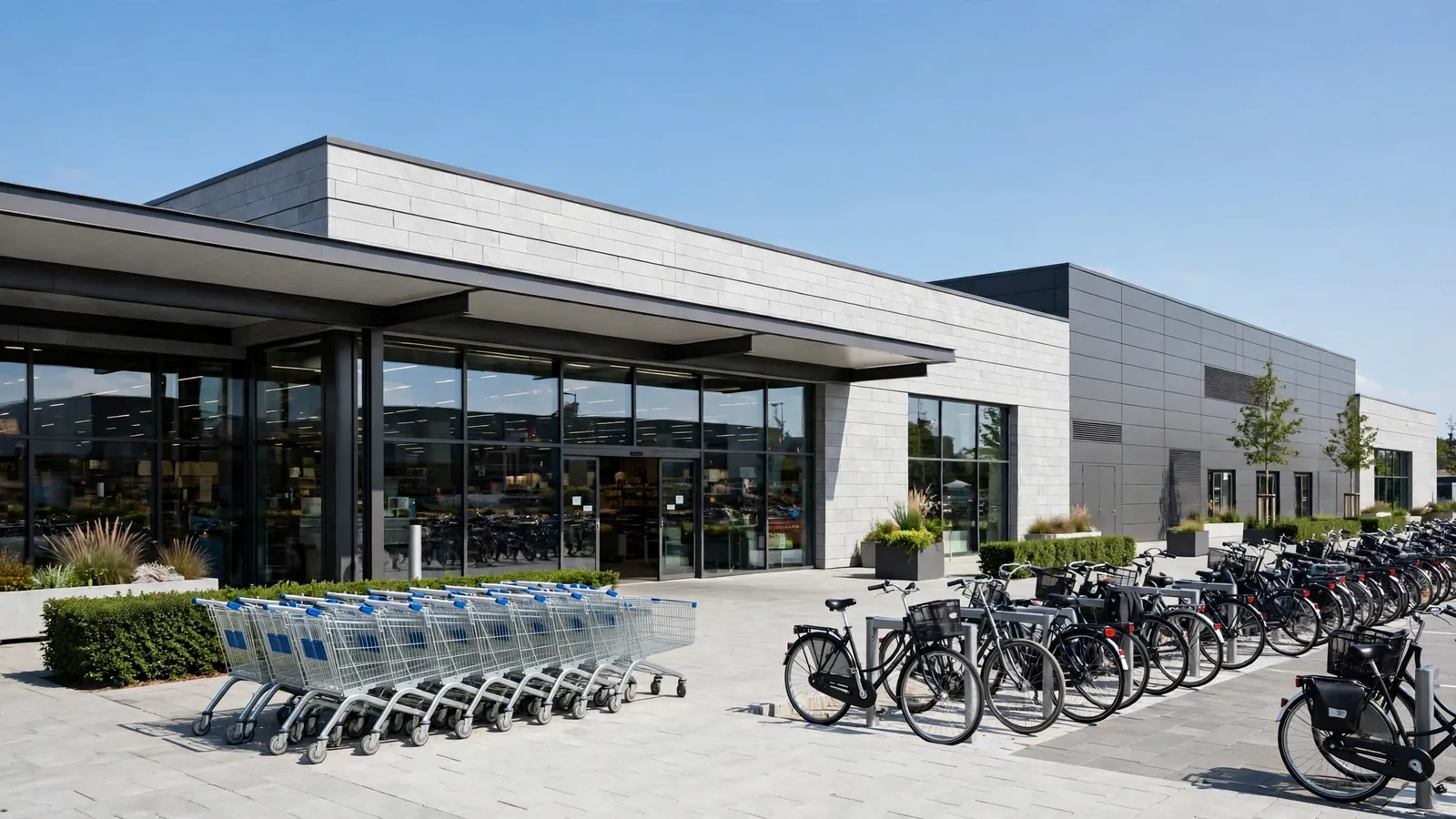
A noodwinkel is an ordinary supermarket that has been prepared to keep operating when almost everything around it has stopped. The reporting describes four defining features. First, power: designated stores must get backup generators — noodstroomaggregaten — because most Dutch supermarkets currently have none. Without power, the tills, the lighting, the automatic doors, card payments (pinnen) and refrigeration all fail, so a supermarket without a generator is simply a dark building full of food it cannot sell. Second, location: the target is that every resident should be within a 15-minute drive of a noodwinkel, or 30 minutes by bicycle, with more locations in densely populated areas and fewer in rural areas. Third, assortment: a noodwinkel would sell essential foodstuffs only — a limited range, not the full supermarket offer. Fourth, supply: the chains must be able to supply each other analogously, without their usual, mutually incompatible computer systems. That last point matters because the modern supermarket is a digital machine: ordering, stock control, distribution and payment all run on software, and if the software is down, the food stops moving. An analogue fallback — paper, phone, manual counting, shared trucks — is the difference between a plan and a wish.
There is one more design detail from the FD reporting: chosen stores should not be inside enclosed shopping centres, because those close in a blackout. A noodwinkel needs to be reachable and openable when the power is out, which means a freestanding store with its own entrance and its own generator, not a unit inside a dark mall.
What triggered the plan
CBL director Marc Jansen has been clear about what accelerated the work. According to BeveiligingNieuws' report of 15 November 2026, Jansen said preparation for fase zwart has accelerated — in his words, it has gone "in een stroomversnelling geraakt" — because of recent incidents: the Albert Heijn cyber incident and attacks on digital refrigeration systems at foreign supermarket chains. Those are two separate triggers, and it matters to keep them separate. The first was the Ahold Delhaize cyber incident of October 2026, in which the parent company of Albert Heijn, Etos and Gall & Gall detected suspicious activity in its IT infrastructure on Sunday 11 October, took systems offline as a precaution, and saw distribution centres stop work, shelves empty and home deliveries suspended for days. The second was the wave of attacks on supermarket refrigeration controllers — Danfoss systems in France on the night of 11-12 October, and a second wave across at least ten European countries, including the Netherlands, on the night of 1-2 November — in which freezers were forced into defrost mode and food had to be discarded. Dutch authorities see no connection between the Ahold Delhaize incident and the refrigeration-controller attacks, and Ahold Delhaize itself has said nothing linking them. Jansen's point was not that the two events were connected, but that together they showed how fast problems can arise. He told the press that the Albert Heijn incident was a warning: food security itself was not endangered, but it showed how quickly a disruption can spread — and that the chain needs an "option B" for more analogue food distribution, so it is not only dependent on digital systems.
What is decided — and what is not
The honest answer is that most of the plan is not decided. What is decided, or at least agreed in principle, is the concept: emergency shops, generators, a 15-minute drive target, essential food only, analogue supply between chains. What is not decided is almost everything that would let a reader find one. Which products must be stocked has not been decided. How storage works has not been decided. Who pays — the chains, the government, or both — has not been decided, and financing is one of the points CBL is discussing with the Ministry of Agriculture (ministerie van Landbouw, LVVN). Which stores, in which towns, will become noodwinkels has not been decided, and no list of locations exists. Any website that publishes a list of noodwinkel locations is inventing it. A final decision on the noodwinkels is expected before summer 2027, according to the reporting of 15 November 2026. Until then, the story is at the interview and reporting stage: there is no official CBL press release on noodwinkels — a search of cbl.nl on 17 November 2026 found none — and no announcement of the noodwinkel plan on rijksoverheid.nl. All CBL positions come via director Marc Jansen's interviews quoted in AD and FD-derived reporting. The government's parallel track is a separate thing: the Landelijk Crisisplan Voedselzekerheid, the National Crisis Plan for Food Security, which is covered on its own page.
Is the Netherlands preparing for war?
This is the question the headlines invite, and it needs a careful answer. No government or CBL source says war is imminent. The government's own line, quoted in fact-checks of the wider stockpiling story, is that the Netherlands is "not at war, but it is not at peace either" and that "there is no emergency now." The fase zwart plan is explicitly precautionary and scenario-based: it prepares for war as one of three triggers, alongside a large-scale cyberattack and a nationwide power outage. The other two triggers are not hypothetical in the way war is — the country has just lived through a major cyber incident at its largest supermarket group and a European refrigeration attack that reached Dutch stores. The plan is best understood as resilience planning: the supermarket sector, which runs on just-in-time delivery and digital systems, is asking what happens if the systems it depends on stop for days rather than hours, and building an answer before it needs one. That is a different claim from "war is coming", and this site does not make the stronger claim. Readers who want the full argument, including the NATO context that has been reported only in secondary sources, will find it on the war-preparation page.
How this site covers the story
Global Cyber Preparedness News is an independent news site, not a government site and not affiliated with CBL, Ahold Delhaize or any supermarket chain. Every fact on this hub comes from the sources listed at the bottom of the page, with the date it was reported. Where a fact could not be verified — for example, the exact wording of the paywalled AD article, or whether Lidl is part of the noodwinkel talks — this site says so, and marks the item DEVELOPING rather than presenting it as fact. The story is moving: the Landelijk Crisisplan Voedselzekerheid is due to be adopted in the first quarter of 2027, the noodwinkel decision is expected before summer 2027, and the Ahold Delhaize investigation is ongoing, with the attacker, the method and the question of stolen data all still open. The live-updates page carries each new development as it is confirmed, with the time it was checked. The pages linked below go deeper: what fase zwart means, how a noodwinkel would work, which chains are involved, who Marc Jansen is, the full Albert Heijn timeline, the freezer hacks from the Dutch angle, the government's food-security plan, the 72-hours-or-8-days argument, the Denk vooruit emergency kit, Denmark's model, Rotterdam's role, how you will be warned, what war preparation actually means, and what is still not decided.
Frequently asked questions
Fase zwart (phase black) is the Dutch supermarket sector's term for the most extreme disruption level — beyond 'code rood' (code red) — in which normal food supply fails for a long period because of war, a major cyberattack or a prolonged nationwide power outage. It is a sector term used by CBL and the supermarket chains, not a term found in any published Dutch government emergency plan.
A noodwinkel is an emergency shop: an existing supermarket designated to keep operating in a crisis, fitted with a backup generator, selling essential food only, and able to be supplied analogously — without the usual computer systems. The target is that every resident is within a 15-minute drive, or 30 minutes by bicycle, of one.
Het Financieele Dagblad first reported the plan on 31 October 2026. The newspaper AD reported it more widely on 15 November 2026, which is when it became national news.
About 4,500, according to the reporting of 15 November 2026. A portion of them — the number has not been decided — would become noodwinkels. No new stores would be built.
No. The plan is the opposite: it is about keeping a portion of supermarkets open in a crisis. Normal supermarkets are open as usual, and there is no emergency now, according to the government's own line.
Two separate October 2026 events, according to CBL director Marc Jansen: the Ahold Delhaize cyber incident that disrupted Albert Heijn, and attacks on digital refrigeration systems at foreign supermarket chains. Dutch authorities see no connection between the two events.
No. The plan prepares for war as one of three scenarios, alongside a major cyberattack and a nationwide blackout. No government or CBL source says war is imminent, and the government says there is no emergency now. The plan is precautionary and scenario-based.
That has not been decided. A final decision on the noodwinkels is expected before summer 2027. No store list, product list or funding decision exists yet, as of 17 November 2026.
Figures are given with their snapshot time and source. Developing items are marked as developing. Last checked Tuesday 17 November 2026, about 12:50 PKT.