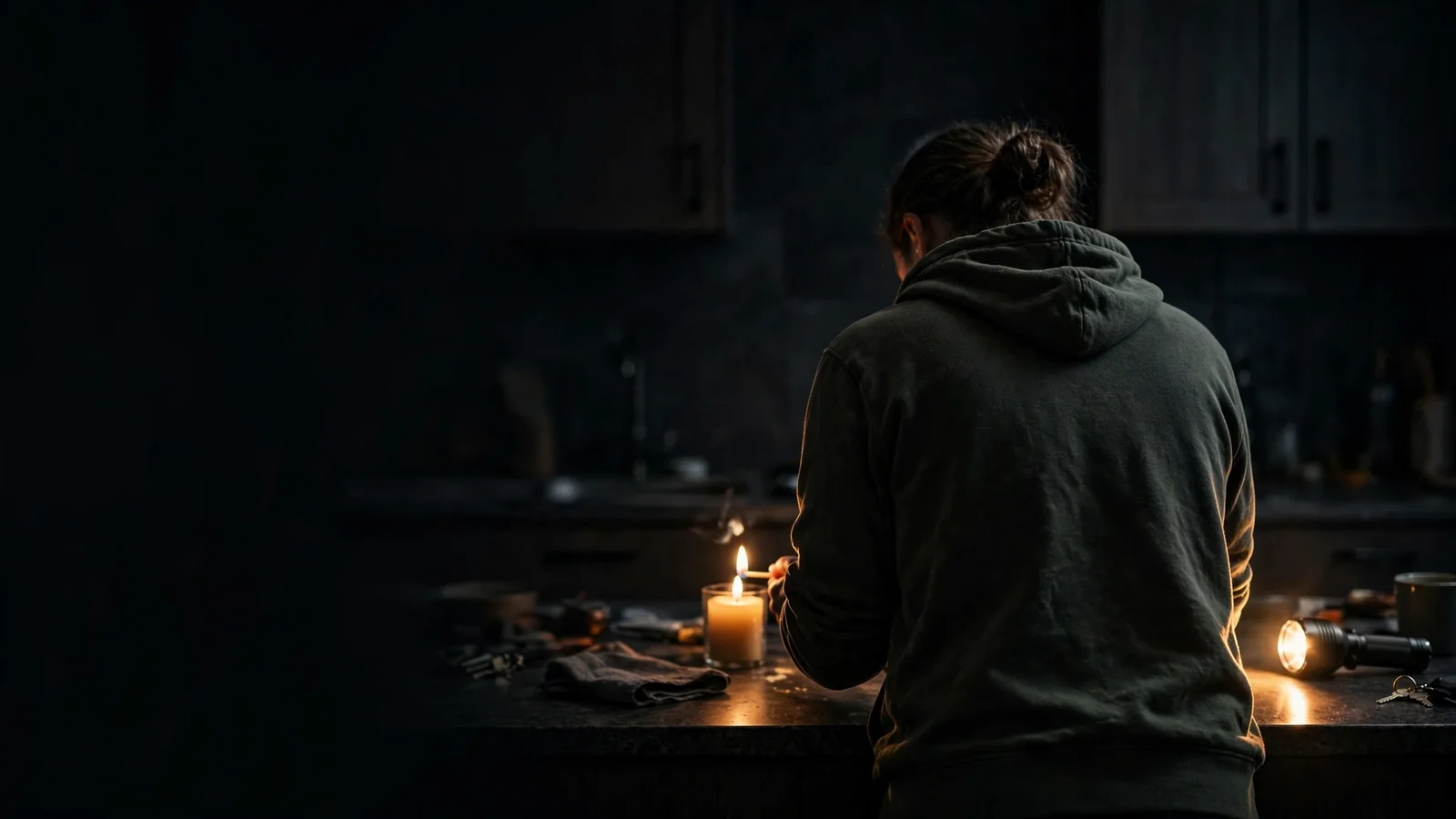
What to Do in the First Hour of a Blackout or Cyber Outage
A blackout rarely announces itself. The lights go out, the television dies, the fridge hums to a stop, and the first question is what to do next. The official guidance from governments across Europe is consistent, and it is mostly about not making things worse in the first hour: keep the fridge shut, find out what is happening on the radio, check on vulnerable neighbours, and do not drive to the supermarket. This page is a practical checklist for the first hour, drawn from official preparedness guidance, and it applies whether the cause is a power failure, a cyberattack or something nobody has identified yet.
In short
In the first hour of a blackout, do four things. First, keep the fridge and freezer doors closed: a closed fridge keeps food cold for hours and a full freezer for much longer, and every opening lets cold air out. Second, get information from a battery or wind-up radio and from official alerts — NL-Alert in the Netherlands, or your local equivalent — rather than from rumours. Third, use a torch, not candles, for light, and unplug sensitive electronics to protect them from a surge when power returns. Fourth, do not drive to the supermarket: shops may be closed, card payments may not work, and the roads may be dangerous without traffic lights. Check on elderly or vulnerable neighbours, use cash if you need to buy anything, and eat refrigerated food before frozen food if the outage goes on. If the outage is a cyber incident rather than a power cut, the same steps apply — and do not spread unconfirmed claims about the cause.
Minutes 0 to 10: stay calm, stay put, keep the cold in
The first minutes are the ones that matter most for your food. Do not open the fridge or the freezer to check on things: a closed fridge keeps food cold for hours and a full freezer keeps food frozen for much longer, and every opening lets the cold out and shortens that time. Work out what you need without opening the doors, and make a plan for what you will eat first if the outage goes on: refrigerated food before frozen food, and the most perishable items first. Switch off or unplug sensitive electronics such as computers and televisions, both to protect them from a power surge when electricity returns and to save the battery of anything you are running on a power bank. Use a torch for light rather than candles: a torch is in every official emergency kit, and candles are a fire risk in a dark house, especially if you are moving around. If you have a gas hob, remember that a modern gas cooker may need electricity for its ignition. Do not use a barbecue, a camping stove or a generator indoors: they produce carbon monoxide, which is colourless, odourless and lethal. If anyone in the house depends on powered medical equipment, check it now and follow the plan you should already have for it — and if you do not have one, make one once the power is back.
Get information: radio first, rumours last
The second job is to find out what is happening, and the radio is the tool every official guide names. A battery or wind-up radio is in the emergency-kit lists of the Netherlands, the United Kingdom, Sweden, Norway, Denmark, France, Germany, Finland, Belgium, Canada and Japan, because radio keeps broadcasting when the internet and the mobile networks do not. In the Netherlands, the official warning channel is NL-Alert, which sends a test message twice a year, on the first Monday of June and December, around noon, and the public sirens are tested on the first Monday of every month at noon, sounding for one minute and 26 seconds. If you hear a siren at any other time, go inside, close the windows and doors, and follow radio and television. In Norway, NRK P1 is the designated emergency channel; in Denmark, DR broadcasts emergency announcements on FM radio. In the United States, the Emergency Alert System is the broadcast channel: a nationwide test was held on Tuesday 17 November 2026 at 2:20 p.m. ET, on radio and television only, not on mobile phones. Treat social media with care in the first hour. The PolitiFact fact-check of 16 November 2026 found no evidence for viral claims of a 90-day global blackout starting on 17 November 2026 and rated them false. Rumours travel faster than official information in a blackout, and acting on them — panic-buying, or driving somewhere you do not need to go — makes the situation worse for everyone.
Food and water: what to eat, what to save
Once you know the outage is not ending in minutes, think about food in the right order. Eat refrigerated food first, then frozen food, then long-life food: that way the food that spoils fastest is used while it is still safe, and the food that keeps is saved for later. Do not taste food to decide whether it is safe, and do not eat anything that has warmed up and smells off — when in doubt, throw it out, because food poisoning during a blackout is a second emergency you do not need. Keep the fridge and freezer closed between decisions, and if you have cool bags or ice packs, use them to keep the most valuable refrigerated items cold. Water is the other priority. If the taps are still running, fill clean containers and the bath while you can: a power cut can affect water pumping, and the Dutch guidance is three litres of water per person per day. If you already keep a 72-hour stock at home, as the Denk vooruit campaign advises, you do not need to do anything about food or water in the first hour at all — which is the point of having the stock. If you do not, this is the moment to understand why the official advice exists, and to build the stock once the power returns.
Cash, not cards: why the wallet matters
One of the first things the Iberian blackout of 28 April 2025 showed is that card payments stop when the power stops. Card machines need electricity and a network connection, and both were gone, so shops that stayed open went cash-only and cash machines stopped working. The same applies to a cyber outage that takes payment networks down even while the lights stay on. Keep some cash at home in small notes and coins, as the Dutch guidance advises — about 70 euros per adult and 30 euros per child, based on a calculation by the budget institute Nibud — and keep it somewhere you can find in the dark. In the first hour, do not go out to find a cash machine: it will not be working, and the roads may be dangerous without traffic lights. If you need to buy something, use the cash you already have, and buy only what you need. The Danish guidance makes a related point: keep your physical payment cards with you and remember your PINs, because the card in your phone may not work without power or a network.
What not to do in the first hour
Some things make a blackout worse, and they are worth listing plainly. Do not drive to the supermarket: shops may be closed, card payments may not work, shelves may already be empty, and the roads are dangerous without traffic lights — and during the Iberian blackout, petrol stations could not pump fuel either. Do not panic-buy: buying everything in sight empties the shelves for everyone else and leaves you with food you cannot store or cook. Do not open the fridge or freezer repeatedly to check on the food. Do not run a generator indoors or in a garage, and do not use a barbecue or camping stove inside: carbon monoxide kills. Do not spread unconfirmed claims about the cause, especially claims that it is a cyberattack or that a war has started: the Iberian blackout was not a cyberattack, the FAA ground stop of 13 November 2026 was not a cyberattack, and in both cases the rumours ran ahead of the facts. Do not call the emergency number to ask when the power will return: keep the lines free for emergencies, and check official channels instead. And do not assume the outage is short: prepare for it to last, and be pleasantly surprised if it does not.
After the first hour: the 72-hour mindset
If the power is still out after an hour, shift from reacting to managing. Work through the food in the order above, keep the radio on for official updates, and check on elderly or vulnerable neighbours — the Dutch Denk vooruit campaign's third step is to talk to each other and help each other, and a blackout is when that matters most. Conserve your phone battery: use it for essential calls and official information, not for scrolling, and keep a power bank charged as part of your kit. If you have to leave the house, take your emergency kit — water, long-life food, torch, radio, medication, documents and cash — rather than leaving it behind. And when the power returns, do the unglamorous work: throw away food that warmed up, restock what you used, recharge the power bank, and write down what you wished you had. Then build the 72-hour kit the official guidance describes, so that the next first hour is a routine, not an emergency. The detailed numbers are on our page on how much food and water to store, and the printable list is on our emergency kit checklist page.
Frequently asked questions
Keep the fridge and freezer doors closed, use a torch for light, and switch on a battery or wind-up radio to find out what is happening. Do not open the fridge to check on the food — every opening lets cold air out and shortens the time the food stays safe.
No, not unless you have to. A closed fridge keeps food cold for hours and a full freezer for much longer. Plan what you need before you open the door, take it out quickly, and close the door again. If the outage goes on, eat refrigerated food before frozen food.
A closed fridge keeps food cold for hours, but the exact time depends on the fridge, how full it is and how warm the room is. Do not rely on a fixed number: keep the door closed, and throw out anything that has warmed up and smells off. When in doubt, throw it out.
A full freezer keeps food frozen much longer than a half-empty one, and a closed freezer lasts far longer than one that is opened repeatedly. Keep the door shut. If the outage goes on, eat the frozen food before it thaws, and do not refreeze food that has thawed.
Yes, switch off or unplug sensitive electronics such as computers and televisions. This protects them from a power surge when electricity returns, and it saves battery on anything running from a power bank. Leave one light switched on so you know when the power comes back.
Use a battery or wind-up radio — it is in nearly every official emergency kit. In the Netherlands, follow NL-Alert and the siren instructions; in Norway, NRK P1 is the emergency channel; in Denmark, DR broadcasts on FM. In the US, the Emergency Alert System broadcasts on radio and television.
No. Shops may be closed, card payments may not work, shelves may be empty, and the roads are dangerous without traffic lights. During the Iberian blackout, petrol stations could not pump fuel either. Use the food and water you already have at home.
Only for a genuine emergency — injury, fire, or a medical situation. Do not call to ask when the power will return. Keep the lines free for emergencies and check official channels, such as the radio and your grid operator's announcements, for restoration times.
Figures are given with their snapshot time and source. Developing items are marked as developing. Last checked Tuesday 17 November 2026, about 12:50 PKT.