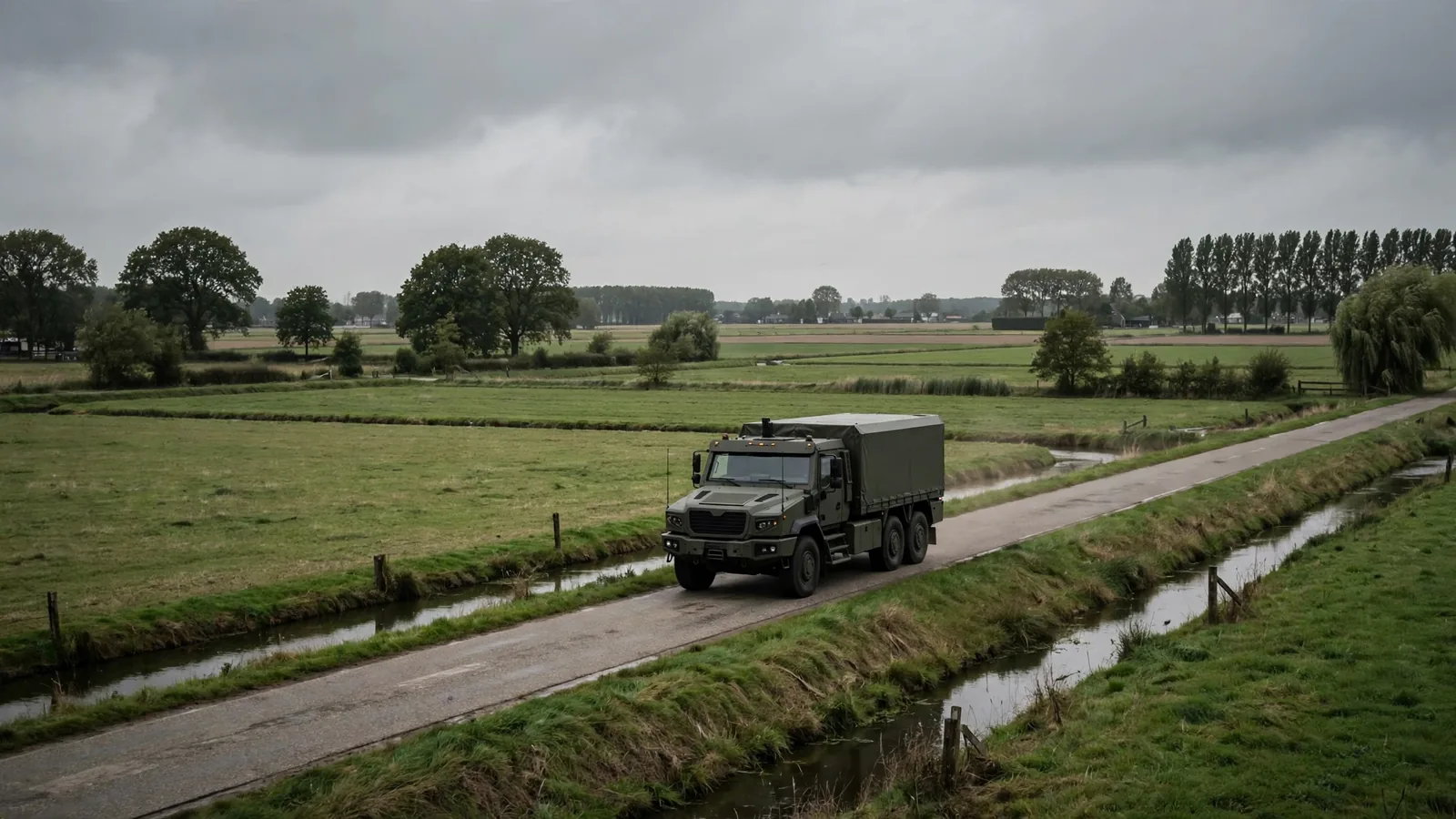
Netherlands Prepares for War: What That Actually Means
"The Netherlands prepares for war" is the headline that has travelled furthest from the fase zwart story — and it is the headline most likely to mislead. No government or CBL source says war is imminent. The government says there is no emergency now. This page explains what war preparation actually means in the Netherlands in November 2026: the scenarios, the NATO context, the concrete steps, and the line between precaution and prediction.
In short
The Netherlands is preparing for war as a scenario, not as an imminent event. No government or CBL source says war is imminent, and the government's own line is that the Netherlands is 'not at war, but it is not at peace either' and that 'there is no emergency now.' What is actually happening is resilience planning: the supermarket sector is preparing noodwinkels for a scenario in which food supply fails because of war, a large-scale cyberattack or a nationwide blackout; the government is preparing the Landelijk Crisisplan Voedselzekerheid, due in the first quarter of 2027; the Denk vooruit campaign is getting households ready for 72 hours without power, water or internet; and in June 2026 the government confirmed a new siren network, linked to a Defence detection system for military threats. The NATO context reported in secondary sources — that NATO asked members to prepare for an Article 5 collective-defence scenario, including the Netherlands having to feed refugees and transiting NATO troops — appears in Kettner on 16 November 2026, citing BNR on 31 October 2026, but the BNR item itself was not read directly, so this site reports it as secondary only (DEVELOPING), not as a confirmed official driver of the noodwinkel plan. War preparation, in this story, means preparing the food system, the warning system and the household to cope if war disrupts them — not mobilising for a war that is expected.
The headline and the reality
The headline "the Netherlands prepares for war" is true in one sense and misleading in another. It is true that the Netherlands is preparing for a scenario in which war disrupts the country — that is one of the three triggers for fase zwart, alongside a large-scale cyberattack and a nationwide blackout, and it is the scenario the noodwinkel plan, the government food-security plan and the new siren network are all, in part, designed for. It is misleading if it is read as "war is coming" or "war is imminent", because no government or CBL source says that. The government's own line, quoted in fact-checks of the wider stockpiling story, is that the Netherlands is "not at war, but it is not at peace either" and that "there is no emergency now." The distinction is between a scenario and a forecast. A scenario is a planning tool: "what would happen if…?" A forecast is a prediction: "this will happen." The Netherlands is doing the first, not the second. The country is asking what would happen to its food supply, its warning system and its households if war disrupted them, and building the answers before it needs them. That is precaution, not prediction, and it is the same logic as the Denk vooruit campaign, which was launched in November 2025 — a year before the fase zwart publicity — without any claim that a specific emergency was imminent.
What war would do to Dutch food
War would disrupt Dutch food in several ways, and the noodwinkel plan is designed for the combination, not for a single one. First, it would disrupt supply lines: the Netherlands imports much of its food through Rotterdam, and a war that closes sea lanes, blocks the port or disrupts shipping would cut the flow at its source. Second, it would disrupt the digital systems: a war that includes cyberattacks on logistics, distribution and payment systems would stop food moving even if the food itself existed — the lesson of the Ahold Delhaize incident, applied at national scale. Third, it would create new demands: a country at war, or a country through which allied troops move and into which refugees arrive, needs to feed more people, in different places, under worse conditions — the NATO context reported in secondary sources, covered below. And fourth, it would disrupt the workforce: the people who drive the trucks, run the distribution centres and staff the shops may themselves be affected, called up, displaced or unable to travel. The noodwinkel plan addresses the last mile of that disruption — the shop that can still sell essentials when the power and the computers fail — but it does not address the whole of it. The port, the distribution centres, the workforce and the refugees are questions for the government's Landelijk Crisisplan Voedselzekerheid, not for the supermarket sector alone, which is why the two plans need to fit together, and why the government's plan, due in the first quarter of 2027, is the document that will show whether the country has a whole answer or only a partial one.
The NATO context (DEVELOPING — secondary only)
One piece of context for the war scenario is reported only in secondary sources, and this site marks it as such. According to Kettner on 16 November 2026, citing BNR on 31 October 2026, NATO asked members to prepare for an Article 5 (collective-defence) scenario, and that is a driver of the noodwinkel plan — including the Netherlands having to feed refugees and transiting NATO troops. The BNR item itself was not read directly in the research for this site, so the claim is plausible context, not a confirmed official driver, and it is reported here as DEVELOPING. The context is worth understanding, even in its unverified form, because it explains why a food plan would be part of war preparation at all. Article 5 is NATO's collective-defence clause: an attack on one member is an attack on all. If Article 5 were invoked, the Netherlands — as a NATO member, a transit country on the way to the eastern flank, and a country with a major port — would need to move allied troops through its territory, receive refugees, and keep its own population fed while doing both. That is a food-security task, not only a military one, and it is the kind of task the noodwinkel plan and the government food-security plan are designed for. But until the BNR item or a NATO or Dutch government source is read directly, the Article 5 driver should be treated as reported context, not as a confirmed fact, and coverage that presents it as the proven reason for the noodwinkel plan is going beyond the evidence.
The concrete steps: sirens, kits, shops, plans
War preparation in the Netherlands in November 2026 is not mobilisation. There is no call-up, no rationing, no evacuation, no declaration. What there is, concretely, is four things. First, the warning system: in June 2026 the government confirmed a new siren network, linked to a Defence detection system for military threats, with nationwide coverage and central control — a system built, in part, to warn of a military threat, not only of a fire or a flood. Second, the household: the Denk vooruit campaign, launched November 2025, with a new phase in October 2026, tells households to keep a 72-hour kit and a plan, and 44% of Dutch people now have a kit. Third, the shops: the noodwinkel plan, reported October–November 2026, would give the country emergency supermarkets with generators and essential food, though no store has been designated and the decision is expected before summer 2027. Fourth, the government plan: the Landelijk Crisisplan Voedselzekerheid, due in the first quarter of 2027, with a cyber-incident playbook and a proposed 2–3 day stock at supermarkets and distribution centres. Those four steps are the whole of the war preparation that can be verified as of 17 November 2026. They are significant — a country that rebuilds its sirens for military threats, advises every household to keep a kit, and plans emergency supermarkets is a country that takes the war scenario seriously — but they are resilience steps, not war steps, and they are the same steps that would be taken for a cyberattack or a blackout, which is why the fase zwart plan lists all three triggers together.
What war preparation is not
Four things war preparation, in this story, is not. It is not a declaration of war, and it does not mean the Netherlands is at war: the government says it is not at war. It is not a prediction that war will happen: a scenario is not a forecast, and no date, no adversary and no specific threat has been named by any official source in the research for this site. It is not mobilisation: there is no call-up of reservists, no requisitioning, no rationing and no evacuation in the reporting, and the steps that are being taken — sirens, kits, shops, plans — are civilian resilience steps, not military ones. And it is not a secret: the plans have been reported in the national press, debated in parliament, and described by CBL's director in interviews. The secrecy claim sometimes appears in social-media discussion of the story, but it does not survive the evidence: the FD reported the noodwinkel plan on 31 October 2026, AD on 15 November 2026, the Tweede Kamer debated the food-security plan on 23 September 2026, and the Denk vooruit booklet was delivered to over 8.5 million households. A plan that is debated in parliament and delivered to every household is not a secret plan. Readers who encounter claims of secret mobilisation, secret rationing or a secret war date should treat them as unverified, and should check them against the sources listed on this page.
How to read war headlines
Readers will keep seeing "the Netherlands prepares for war" in headlines, and a few checks will keep the reporting honest. If a headline says war is imminent, check whether any government or CBL source says that — as of 17 November 2026, none does. If a headline says the Netherlands is mobilising, check what has actually been mobilised — the verified steps are sirens, kits, shops and plans, not troops. If a headline treats fase zwart as a war declaration, check whether fase zwart is a government term — it is not, it is a sector term, and no government document uses it. And if a headline cites NATO as the driver, check whether the source is a NATO or Dutch government document or a secondary report citing BNR — as of 17 November 2026, it is the latter, and it is marked DEVELOPING on this site. The useful question is not "is war coming?" — no public source can answer that — but "is the country ready if its food system is disrupted, whatever the cause?" That is the question the noodwinkel plan, the government plan and the Denk vooruit campaign are trying to answer, and it is the question this hub will keep tracking, with the sources and the dates, as the 2027 decisions approach.
Frequently asked questions
It is preparing for war as a scenario — one of three triggers for the fase zwart plan, alongside a major cyberattack and a nationwide blackout. No government or CBL source says war is imminent, and the government says there is no emergency now.
No government or CBL source says war is imminent, as of 17 November 2026. The government's line is that the Netherlands is 'not at war, but it is not at peace either' and that 'there is no emergency now.'
DEVELOPING — secondary only. Kettner on 16 November 2026, citing BNR on 31 October 2026, reports NATO asked members to prepare for an Article 5 scenario, including the Netherlands feeding refugees and transiting NATO troops. The BNR item was not read directly, so this is plausible context, not a confirmed official driver.
No. There is no call-up, rationing, evacuation or declaration in the reporting. The verified steps are civilian resilience: a new siren network, the Denk vooruit household campaign, the noodwinkel plan and the government food-security plan.
In June 2026 the government confirmed a new siren network, linked to a Defence detection system for military threats, with nationwide coverage and central control — a system built, in part, to warn of a military threat.
No. Fase zwart is a sector term used by CBL and the supermarket chains, not a term in any published Dutch government emergency plan, and it has not been declared or activated.
By disrupting supply lines through Rotterdam, disrupting digital logistics and payment systems, creating new demands from refugees and transiting troops, and disrupting the workforce that moves and sells food.
The Landelijk Crisisplan Voedselzekerheid is due in the first quarter of 2027, the noodwinkel decision is expected before summer 2027, and the Strategic Agenda for Food Security follows before summer 2027. This hub will update as each is published.
Figures are given with their snapshot time and source. Developing items are marked as developing. Last checked Tuesday 17 November 2026, about 12:50 PKT.