How Food Supply Chains Break: Power, Digital Systems and Transport
A supermarket shelf looks permanent, but the food on it arrived through a chain that is thinner than most shoppers realise. In October 2026, a cyberattack on Ahold Delhaize stopped distribution centres in the Netherlands and fresh produce vanished from Albert Heijn shelves within days. In April 2025, a blackout across Spain and Portugal closed supermarkets and stopped card payments within hours. In October and November 2026, hackers forced supermarket freezers into defrost mode across Europe and food had to be thrown away. This page explains the three ways a food supply chain breaks — power, digital systems and transport — using only those verified cases.
In short
Food supply chains break in three ways. First, power: without electricity, tills, lighting, automatic doors, card payments and refrigeration all fail, which is what happened across Spain and Portugal on 28 April 2025, when about 60 million people lost power. Second, digital systems: modern supermarkets run on shared IT, so when Ahold Delhaize switched its systems off after suspicious activity on 11 October 2026, distribution centres stopped, ordering stopped and shelves emptied within days. Third, transport and the cold chain: refrigerated warehouses and lorries depend on controllers and fuel, and the October–November 2026 freezer attacks showed that even the equipment keeping food cold can be turned against it. The common thread is that most supermarkets hold only about a day and a half of stock in their regional distribution centres, according to Erasmus University researcher René de Koster on 29 October 2026 — enough while supplies run normally, but not when the flow stops.
The three ways food stops moving
Food reaches a supermarket through a chain with three weak links, and each one failed somewhere in 2025 or 2026. The first link is power. A supermarket without electricity cannot open its doors, run its tills, take card payments or keep its fridges cold. The second link is digital: ordering, warehouse management, supplier ordering and home delivery all run on the same IT systems, so one incident can stop all of them at once. The third link is transport and temperature: food moves in refrigerated lorries and warehouses, and if the cold chain breaks — whether because the power is out or because a controller has been hacked — the food itself becomes unsafe and must be discarded. None of these is theoretical. Each one has a dated, sourced example in the past year, and this page works through them one by one. The point is not that food systems are fragile in the abstract. It is that the same three failure modes keep recurring, and that understanding them is the difference between panic and preparation.
Power: what happens when the lights go out
The clearest power example is the Iberian blackout of 28 April 2025. At 12:33 CEST, about 60 percent of Spain's electricity supply vanished within five seconds, according to grid operator Red Eléctrica, and about 60 million people across Spain and Portugal were affected. Supermarkets closed or ran on generators where they had them. Shoppers queued for canned goods, bottled water, toilet paper, torches, portable gas stoves and wind-up radios, and shelves emptied. Card machines failed, so some shops went cash-only or gave credit to regular customers. Refrigeration warmed and meat and dairy had to be discarded. Petrol stations could not pump fuel, trains stopped, traffic lights went out and cash machines stopped working. Power was restored through the evening and night, with rural areas waiting 10 to 18 hours and some pockets up to 24 hours. Eight people died as direct consequences of the blackout. The economic impact was estimated at 1.6 billion euros by the Spanish employers' organisation CEOE. The cause has still not been definitively established: investigations describe a multifactorial failure involving voltage surges, oscillations and successive generator disconnections. The Portuguese prime minister said there was no indication of a cyberattack, and the European Council said there were no indications of a cyberattack. The lesson for food is simple: a supermarket is an electrical device. Without power it cannot sell, cannot keep food cold and cannot take your card.
Digital systems: when the computers stop, the food stops
The Albert Heijn case of October 2026 shows the digital failure mode. On Sunday 11 October 2026, Ahold Delhaize detected suspicious activity in its IT infrastructure and took systems offline as a precaution. The company's own statement of 19 October 2026 records what followed: logistics systems were switched off, online grocery orders could not be delivered, and work stopped completely in some distribution centres. Physical stores stayed open and tills worked, but fresh produce — fruit and vegetables — was hardest hit, and Albert Heijn chief executive Margaret Versteden-van Duijn told NOS on 12 October that shelves would empty if the disruption went on longer. Erasmus University supply-chain researcher René de Koster explained why on 29 October 2026: regional distribution centres hold about a day and a half of stock, which is enough when supplies are running normally, but as soon as that flow stops, the stock runs out quickly. Ordering, distribution-centre operations and supplier ordering all depend on the same IT systems, so when they went down, none of that could happen. De Koster's own recommendation — that supermarkets hold a month's stock of a selection of important products — is his proposal, not policy. The Ahold Delhaize incident was confirmed by the company on 19 October 2026 to have resulted from the malicious actions of others. It has not named an attacker, has not said it was ransomware, and has said there was no evidence at that point that customer, associate or partner data had been taken. Dutch authorities see no connection between the Ahold Delhaize incident and the refrigeration-controller attacks described below.
The cold chain: when the fridges themselves are the target
The third failure mode is the cold chain — the refrigerated warehouses, lorries and shop freezers that keep food safe between farm and shelf. In the night of 11–12 October 2026, attackers remotely took control of Danfoss refrigeration controllers in French supermarkets — reports put the number at about 250 to 350 stores in some accounts and about 700 French stores in others — and forced evaporators into defrost mode. Food had to be discarded. France's CERT-FR issued alert CERTFR-2026-ALE-012 on 12 October 2026, updated on 13 and 16 October, naming Danfoss AK-SM and AK-SC controllers and later extending to Copeland and Dixell XWEB systems. Danfoss said on 13 October 2026 that affected systems should be disconnected from the internet, and that most affected equipment was legacy hardware no longer receiving security updates. A second wave followed in the night of 1–2 November 2026, driving refrigeration and freezer temperatures up to about 50 degrees Celsius in stores across at least 10 European countries, including Belgium, Estonia, Finland, Ireland, Italy, Luxembourg, the Netherlands, Portugal, Germany and Sweden, according to BBC reporting of 3 November 2026. Later reports put the second wave at 13 countries. EU Agriculture Commissioner Christophe Hansen said on 3 November 2026 that it was a deliberate attempt to disrupt the food supply chain. On 5 November 2026, the US agencies CISA and the FBI, together with the health, agriculture and transport departments, issued a joint fact sheet on refrigeration and cold-chain attacks. Attribution: French authorities publicly attributed the first wave to Iran's IRGC Shahid Kaveh cyber unit on 9 November 2026, according to secondary reporting; the pro-Russian groups NoName057(16) and Z-Pentest claimed the second wave on Telegram on 3 November 2026 — a claim, not confirmed attribution — and investigators had not confirmed the two waves are connected as of 9 November 2026.
Transport: the last link in the chain
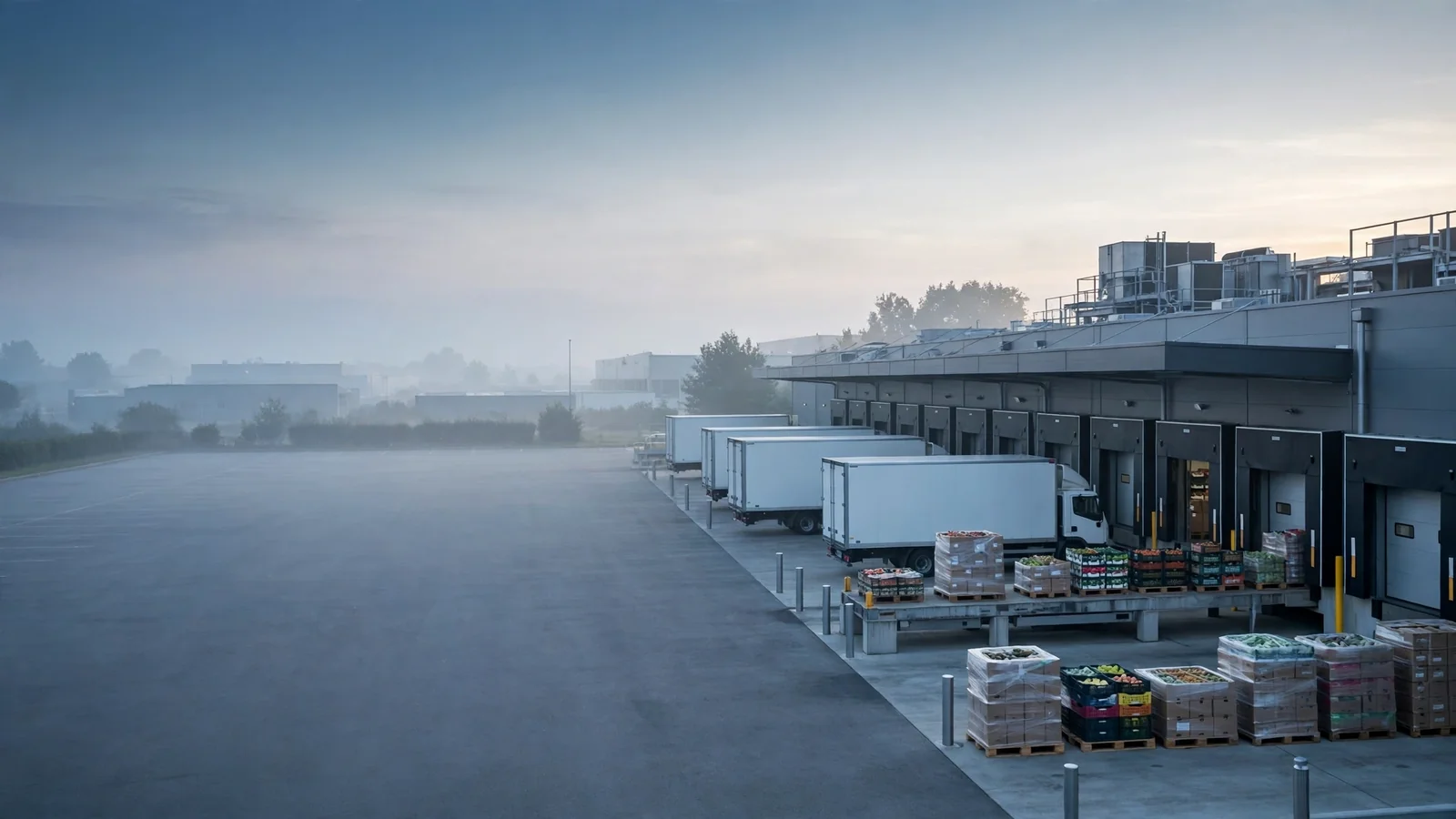
Even when shops have power and working computers, food still has to move. The Netherlands illustrates how concentrated that movement is. Albert Heijn has four regional distribution centres — in Tilburg, Pijnacker, Zaandam and Zwolle — each supplying about 200 supermarkets. When the IT systems stopped on 11–12 October 2026, work at a standstill was reported in multiple distribution centres, with only Zaandam still operating, according to a supplier email obtained by RTL Z, and suppliers were told to deliver to Zaandam only. The port of Rotterdam is the other end of the same chain: it is the European Union's largest port, handling 13.4 million TEU of containers in 2024 out of 100.9 million TEU handled in the EU's main ports — about 13.3 percent — and 397.3 million tonnes of maritime freight, or 11.8 percent of all goods handled in EU ports, according to Eurostat. Food that arrives by sea, and food that leaves a distribution centre by lorry, both depend on fuel, roads and working logistics software. During the Iberian blackout, petrol stations could not pump fuel, which meant lorries could not refuel either. A chain that moves food just in time has very little slack anywhere in it, and the transport link is where a local failure becomes a regional one.
Why a day and a half of stock matters
The number that explains all three cases is the stock figure. Regional distribution centres hold about a day and a half of stock, according to René de Koster of Erasmus University's Rotterdam School of Management on 29 October 2026. A typical Dutch supermarket chain holds about one week's stock of an individual item, according to trade reporting, and researchers warn shelves can empty within two to three days after a cyberattack on logistics, according to Radboud University research reported in 2026. That is not a failure of planning: it is how a just-in-time system is designed to work. Shops order frequently, in small quantities, because fresh food spoils, warehouse space is expensive and demand is usually predictable. The system is efficient in normal times and brittle in abnormal ones. The Dutch government has noticed. State Secretary Silvio Erkens of the agriculture ministry proposed in October 2026 securing a two- to three-day stock of necessary goods at supermarkets and distribution centres, and the government is preparing a National Crisis Plan for Food Security, the Landelijk Crisisplan Voedselzekerheid, for adoption in the first quarter of 2027. At present there is no legal obligation for supermarkets or distribution centres to hold emergency stock. Researchers from the Clingendael Institute and Erasmus University went further in a report delivered on 18 September 2026, recommending households hold eight days of food instead of three, plus national reserves such as rapeseed oil for 18 months. The cabinet holds to the three-day advice for households, with Erkens saying eight days is impractical for people in small homes, and the government is instead examining a bigger role for supermarkets and distribution centres in longer crises.
What this means for households
None of this means food will run out tomorrow. The Dutch supermarket association CBL's director Marc Jansen said on 15 November 2026 that the Albert Heijn incident was a warning, that food security itself was not endangered, but that it showed how fast problems can arise. The government's own line is that the Netherlands is not at war, but it is not at peace either, and that there is no emergency now. What the cases do show is where the risks sit: fresh food first, because it cannot wait; card payments, because they need power and networks; and the cold chain, because once food warms up it cannot be made safe again. The official household advice across Europe is consistent on the response: keep enough food and water for at least 72 hours, keep some cash, keep a battery radio, and know how you will be warned. The Netherlands' Denk vooruit campaign asks households to cope for 72 hours without electricity, water or internet, with three litres of water per person per day. The detailed official numbers, country by country, are on our page on how much food and water to store, and the practical first-hour steps are on our blackout checklist page.
Frequently asked questions
Not long. Regional distribution centres hold about a day and a half of stock, according to Erasmus University researcher René de Koster on 29 October 2026. Researchers warn shelves can empty within two to three days after a cyberattack on logistics. Fresh produce runs out first because it cannot be stored for long.
Because the system is built just in time: shops order frequently in small quantities, since fresh food spoils, warehouse space is expensive and demand is usually predictable. It is efficient in normal times and brittle when the flow stops. It is a design choice, not an accident.
A system in which food is ordered, delivered and sold in a continuous flow with very little stock held anywhere in the chain, instead of large warehouses of stored goods. When every link works, shelves stay full. When one link stops, there is almost no buffer to absorb the delay.
Yes, and it happened in October 2026. When Ahold Delhaize switched its IT systems off on 11 October 2026, distribution centres stopped, ordering stopped and fresh produce shelves emptied within days. The company's chief executive said on 12 October that shelves would empty if the disruption went on longer.
It warms up, and once it warms up it has to be discarded. During the Iberian blackout of 28 April 2025, refrigeration warmed and meat and dairy were thrown away. In the October–November 2026 freezer attacks, controllers were forced into defrost mode and temperatures rose to about 50 degrees Celsius, spoiling the food inside.
Distribution centres stopped, online orders could not be delivered and fresh produce was hardest hit. Physical stores stayed open and tills worked. Home deliveries were suspended until at least 20 October and all delivery orders up to and including 22 October were later cancelled. Deliveries resumed gradually from 23 October 2026.
The cold chain is the unbroken series of refrigerated warehouses, lorries and shop freezers that keeps food cold from farm to shelf. If it breaks — because the power fails or because a controller is hacked — food warms, becomes unsafe and must be discarded. The October–November 2026 freezer attacks targeted exactly this link.
Do not panic-buy: that empties shelves faster for everyone. Use what you already have at home, follow official advice from your government and local authorities, and keep a basic 72-hour stock of long-life food and water at home so a short disruption does not become an emergency for your household.
Figures are given with their snapshot time and source. Developing items are marked as developing. Last checked Tuesday 17 November 2026, about 12:50 PKT.