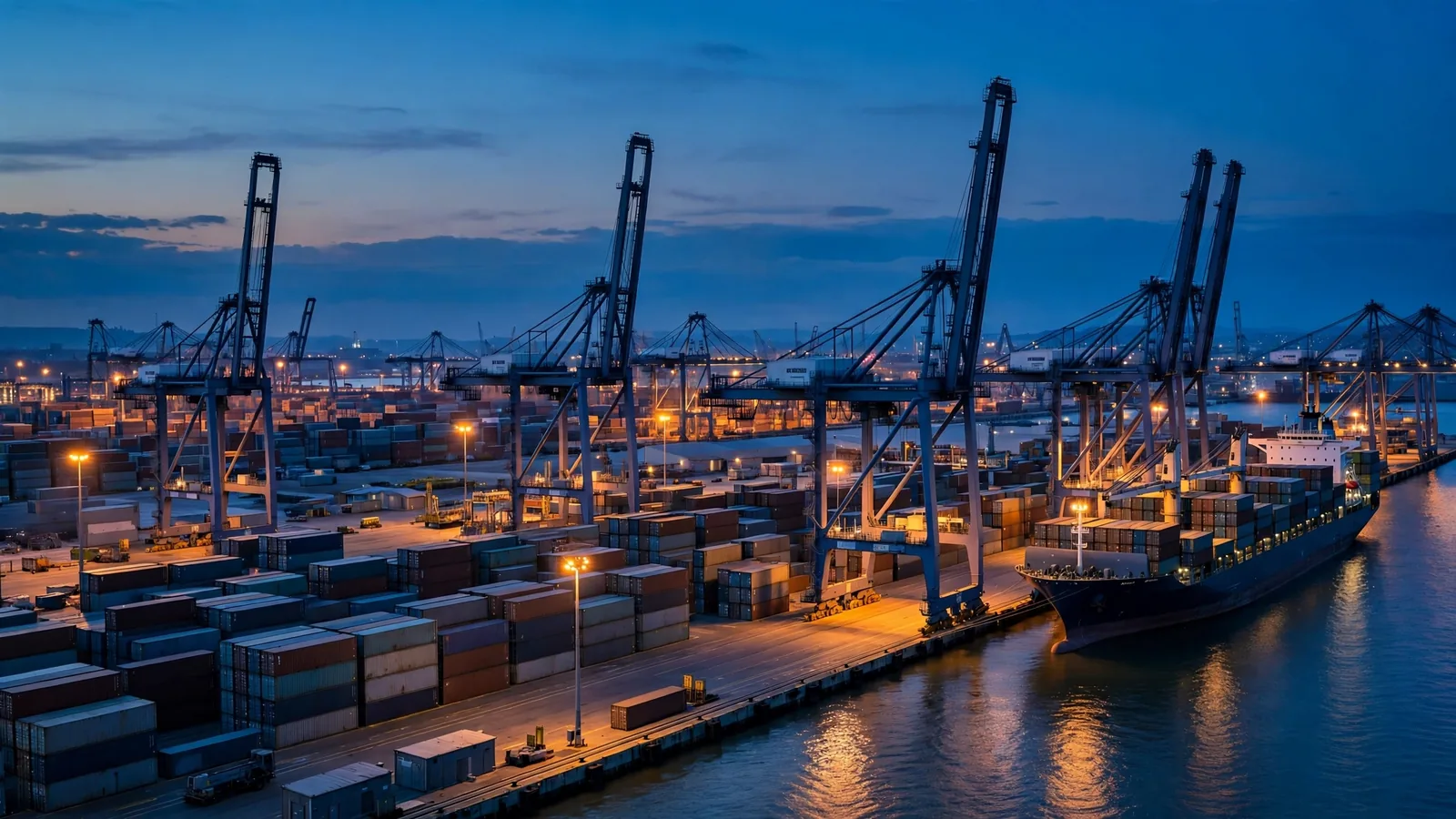
Rotterdam: Why the Netherlands' Food Supply Runs Through One Port
The Netherlands' food supply runs through one port. Rotterdam is the largest port in the European Union, and a large share of the food the country eats — and the food it exports — passes through it. That concentration is a strength in normal times and a vulnerability in a crisis, and it is one of the reasons the fase zwart plan exists. This page explains Rotterdam's role, with the correct Eurostat figures, and why a single-port dependency matters for food security.
In short
Rotterdam is the EU's largest port. In 2024 it handled 397.3 million tonnes of maritime freight, or 11.8% of all goods handled in EU ports, with inward flows of 288.0 million tonnes, or 13.9% of EU inward flows, according to Eurostat (2024 data, published November 2025). It was the EU's largest container port in 2024 with 13.4 million TEU, ahead of Antwerp-Bruges (12.4 million TEU) and Hamburg (7.8 million TEU); total containers handled in main EU ports were 100.9 million TEU, so Rotterdam handled about 13.3% of EU container throughput. The Netherlands as a country handled 538 million tonnes, or 16.0% of the EU total — the largest maritime freight country in Europe. A figure that circulates in some coverage — an inflated share of EU container imports, far above the real share — is WRONG and is not used on this site: the Eurostat figure is about 13.3% of EU container throughput. The port's importance for food is structural: the Netherlands is a major food importer and one of the world's largest agricultural exporters, its supermarket system is just-in-time, and a disruption at Rotterdam — or to the digital systems that run it — would be felt in the shops within days.
The correct figures
The figures on this page come from Eurostat, and they are worth stating precisely, because a wrong figure has circulated widely. In 2024, Rotterdam handled 397.3 million tonnes of maritime freight, which is 11.8% of all goods handled in EU ports. Its inward flows — goods arriving into the port — were 288.0 million tonnes, or 13.9% of EU inward flows. In containers, Rotterdam was the EU's largest container port in 2024 with 13.4 million TEU (twenty-foot equivalent units, the standard measure for containers), ahead of Antwerp-Bruges with 12.4 million TEU and Hamburg with 7.8 million TEU. Total containers handled in the main EU ports were 100.9 million TEU, so Rotterdam's share was about 13.3% of EU container throughput. The Netherlands as a country handled 538 million tonnes in 2024, or 16.0% of the EU total — the largest maritime freight country in Europe. Those are the defensible lines: "Europe's largest port", "13.4 million TEU in 2024 — the EU's biggest container port", and "11.8% of all goods handled in EU ports". A figure that circulates on commercial logistics blogs — that Rotterdam handles about 30% of EU container traffic — is not a Eurostat figure and is treated here as unverified marketing copy. And an inflated figure that appeared in some early leads for this story is wrong, corrected by the Eurostat data, and is not used anywhere on this site. The correction matters because an inflated figure would imply a dependency far greater than the real one, and would mislead readers about the scale of the vulnerability. The real dependency, at 13.3% of EU containers and 11.8% of EU tonnage, is large enough without exaggeration.
Why food runs through Rotterdam
Rotterdam matters for food for three reasons. First, the Netherlands imports a large share of the food it eats, and much of it arrives by sea: fruit, vegetables, coffee, cocoa, grains, oils and animal feed come through the port, are processed or stored in the Netherlands, and are then distributed to supermarkets or re-exported. Second, the Netherlands is one of the world's largest exporters of agricultural products — a paradox that is central to Dutch food security: the country exports high-value food (dairy, meat, vegetables, flowers) and imports the inputs and the staples it needs, so its food system is deeply connected to world trade, and to the port that connects it. Third, the port is the gateway for the just-in-time system: the distribution centres that supply the supermarkets are fed by the port, and the port's efficiency — ships unloaded, containers moved, goods trucked to distribution centres within hours — is what makes just-in-time possible. The port is therefore not a distant piece of infrastructure: it is the first link in the chain that ends on a supermarket shelf. A disruption at Rotterdam, whether physical (a storm, a blockage, a war) or digital (a cyberattack on the port's systems, which are as connected as any supermarket's), would not stay at the port. It would be felt in the distribution centres, and then in the shops, within days — the same 2–3 day horizon that researchers warn about for a cyberattack on logistics.
Just-in-time: efficient and fragile
The Dutch supermarket system is a just-in-time system. Food is not stockpiled in shops; it is ordered, delivered, sold and reordered in a continuous flow, with distribution centres holding about a week's stock of an item and shops holding far less. That system is efficient — it keeps prices low, waste low and shelves full — and it is fragile, because it has little buffer. A disruption anywhere in the chain — at the port, in the distribution centre, in the ordering software — becomes a shortage in the shops within days. The Ahold Delhaize incident of October 2026 showed the fragility from the inside: when the company's systems were taken offline, the distribution centres stopped, and the shelves emptied within a day, even though the food existed somewhere in the system. A disruption at Rotterdam would show the fragility from the outside: the food would not arrive at all, and the distribution centres would have nothing to distribute. The noodwinkel plan, the government stock proposal and the researchers' 8-day recommendation are all, in different ways, responses to that fragility: they add buffer — in the shops, in the distribution centres, in the home, in national reserves — to a system that currently has very little. Rotterdam is the reason the buffer needs to be at the national level, not just the household level: a household can stockpile for 72 hours, but it cannot stockpile against a port closure, and only the state and the sector together can build the resilience that a single-port dependency requires.
The port as a cyber target
Rotterdam's systems are digital, and digital systems can be attacked. The port runs on the same kinds of connected systems as the supermarkets: ordering, tracking, customs, logistics, refrigeration and payment, all run on software, and all connected to the internet or to networks that are. The refrigeration attacks of October and November 2026 showed that the food system's connected equipment can be attacked at scale; the Ahold Delhaize incident showed that a food company's central systems can be taken offline; and the wider cyberattack landscape of 2025–2026 — covered in the attacks hub, from the Polish power-grid wiper attack to the attacks on water systems in the United States — shows that critical infrastructure is a target. This site does not claim Rotterdam has been attacked, and no such claim is made in the research: the port is discussed here as a dependency, not as a victim. But the dependency is the point. A food system that runs through one port, supplied by just-in-time logistics, run on digital systems, is a system with a small number of points of failure, and the fase zwart plan is an attempt to build an alternative — analogue supply, generators, essential stock in the shops — for the day one of those points fails. The port's own resilience planning, and the government's food-security plan, are part of the same answer, and they will be covered as they are published.
What Rotterdam means for the noodwinkel plan
Rotterdam shapes the noodwinkel plan in two practical ways. First, it explains why the plan is national, not local: a disruption at the port affects the whole country, not one town, so the emergency network must be national too — every resident within a 15-minute drive of a noodwinkel, not just the residents of one city. Second, it explains why the plan's analogue supply matters: if the port's digital systems fail, or the distribution centres' systems fail, the food that is already in the country — in the distribution centres, in the shops, in the port's warehouses — still needs to move, and it can only move if the chains can supply each other without computers. The noodwinkel is, in that sense, the last mile of a resilience plan that starts at the port: the port brings the food in, the distribution centres move it, the noodwinkels sell it when nothing else works. A plan that only fixed the shops, without addressing the port and the distribution centres, would be incomplete, and a plan that only fixed the port, without addressing the shops, would leave people with food in a warehouse they cannot buy. The government's Landelijk Crisisplan Voedselzekerheid, due in the first quarter of 2027, is the document that is supposed to join those pieces together, and its publication will be the moment the Rotterdam question — how the country feeds itself if its largest port stops — gets a full official answer.
Frequently asked questions
Yes. Rotterdam is the EU's largest port: it handled 397.3 million tonnes of maritime freight in 2024, or 11.8% of all goods handled in EU ports, according to Eurostat.
13.4 million TEU in 2024 — the EU's largest container port, ahead of Antwerp-Bruges (12.4 million TEU) and Hamburg (7.8 million TEU). Total containers in main EU ports were 100.9 million TEU, so Rotterdam's share was about 13.3%.
Its share is large but not as large as some coverage claims. Eurostat 2024 data puts Rotterdam at about 13.3% of EU container throughput (13.4 million TEU of 100.9 million TEU). This site uses the Eurostat figure only.
Much of the food the Netherlands eats arrives by sea through Rotterdam, and the country's just-in-time supermarket system is fed by the port via distribution centres. A disruption at the port would be felt in the shops within days.
538 million tonnes in 2024, or 16.0% of the EU total — the largest maritime freight country in Europe, according to Eurostat.
No such claim is made in the research for this site. Rotterdam is discussed here as a dependency — a single point of failure in the food system — not as a victim of an attack.
A twenty-foot equivalent unit — the standard measure for container volume. One TEU is one 20-foot container; a 40-foot container counts as 2 TEU.
The noodwinkel plan is national because a disruption at Rotterdam would affect the whole country, and its analogue-supply requirement exists so food already in the country can still move if the port's or the distribution centres' digital systems fail.
Figures are given with their snapshot time and source. Developing items are marked as developing. Last checked Tuesday 17 November 2026, about 12:50 PKT.