UK Be Ready Campaign: The 3-Day Checklist, Item by Item
On 22 October 2026 the United Kingdom's Cabinet Office launched Be Ready, the first stage of a three-year national campaign telling households to keep enough water and food for three days. It is the first national public-awareness campaign of its kind in the UK, and it arrives alongside a separate emergency-broadcasting contingency known as Black Sky, which is covered on its own page. This page sets out the Be Ready checklist item by item, explains what the government said at launch, and separates the campaign from the claims made about it online.
In short
The UK Government's Be Ready campaign was launched on 22 October 2026 by the Cabinet Office, as the first stage of a three-year campaign, with more than 500 organisations signed up. It advises households to keep enough water and food for three days if electricity, water, phone or internet fail. The water advice is 3 litres of drinking water per person per day, which is 9 litres per person for three days, plus more for cooking and washing. The risks named at launch were storms, flooding, power cuts, cyberattacks and hostile states. Research cited at launch found that only 13 per cent of people felt prepared. The campaign builds on existing GOV.UK Prepare guidance and was announced in principle in July 2026.
The launch: 22 October 2026
The Be Ready campaign was launched on 22 October 2026 by the Cabinet Office. It was announced as the first stage of a three-year campaign, developed with the Scottish, Welsh and Northern Ireland governments, councils and resilience forums, and with more than 500 organisations signed up. The campaign had been announced in principle in July 2026, in the Resilience Action Plan implementation report published that month, and it builds on the GOV.UK Prepare guidance that already existed. The National Risk Register was also updated in July 2026, adding cyberattacks on data, water and police systems and digital-resilience failures. At launch, Defence Secretary Wes Streeting warned on BBC Question Time about supply-chain disruption from cyber and climate emergencies, and Security Minister Dan Jarvis launched the campaign. The government's message, as reported at launch, was to be alert but not alarmed: households should take practical steps, gradually, rather than panic buying. The campaign's core message is simple. Keep enough water and food for three days if electricity, water, phone or internet fail. Three days is the horizon, and the checklist below is what the government advises households to keep for that period.
The checklist, item by item
Water comes first. The campaign advises 3 litres of drinking water per person per day, which is 9 litres per person for three days, plus more for cooking and washing. That figure is corroborated by BBC, Sky and Cabinet Office reporting of the launch, but the exact beready.campaign.gov.uk checklist page was not text-fetched in the research for this site, so the item list below is given as reported at launch rather than as a verbatim quotation of the campaign website, and readers should verify the checklist live on the campaign site. Food comes second: non-perishable food that needs no cooking and no fridge, enough for three days. Light and information come next: a torch with spare batteries, a battery or wind-up FM radio, and a charged power bank. Health follows: a first-aid kit and regular medication. Money and documents follow: cash, and copies of important documents. Babies and pets are covered too: supplies for babies and pets where relevant. The list is deliberately ordinary. It does not require specialist equipment, and it does not require buying everything at once. The campaign's emphasis, as reported, is on building the kit gradually, checking it, and keeping it where it can be found in the dark. The three-day figure matches the advice in France, Ireland and the Netherlands, a comparison the government itself noted at launch, and it sits underneath the longer advice in Sweden, Norway and Germany, which ask for a week and ten days respectively.
Why three days, and why now
The government did not present Be Ready as a response to a specific imminent threat. The risks named at launch were broad: extreme weather, floods, wildfires, power cuts, cyberattacks and hostile states. The National Risk Register update of July 2026 had added cyberattacks on data, water and police systems, which shows the risk picture the campaign sits in, but neither the register nor the campaign names a date or an event. The timing reflects a longer process. The campaign was announced in principle in July 2026. It was launched in October 2026, in the same weeks as the European Commission's population preparedness guidelines of 30 October 2026 and the publication of NATO's Resilience Baseline Requirements on 15 September 2026. The research cited at launch found that only 13 per cent of people felt prepared, which the government presented as the reason a public-awareness campaign was needed. The three-year duration also matters: Be Ready is not a one-week publicity push, but the first stage of a campaign intended to run for three years, with further stages to follow. Readers should therefore treat it as a standing programme, not as an emergency warning.
What Be Ready is not
Three distinctions keep the campaign straight. First, Be Ready is not a NATO instruction. NATO's Resilience Baseline Requirements, published 15 September 2026, are state-level requirements and never mention household kits or 72 hours. Be Ready is a United Kingdom government campaign, decided in London, not in Brussels at NATO headquarters. Second, Be Ready is not the Black Sky plan. Black Sky is the BBC's emergency-broadcasting contingency for a total national grid failure, reported by the BBC's David Sillito on 7 November 2026, and it is covered on its own page. The two are separate: one is a public campaign telling households to keep three days of supplies, the other is a broadcaster's contingency for keeping radio on air during a prolonged blackout. Third, Be Ready is not a warning that a blackout, cyberattack or war is imminent. The Cabinet Office said there was no specific threat behind the Black Sky contingency, and no specific threat was attached to Be Ready at launch. The campaign's own framing is preparedness as a habit, not preparedness as a countdown.
How to build the kit gradually
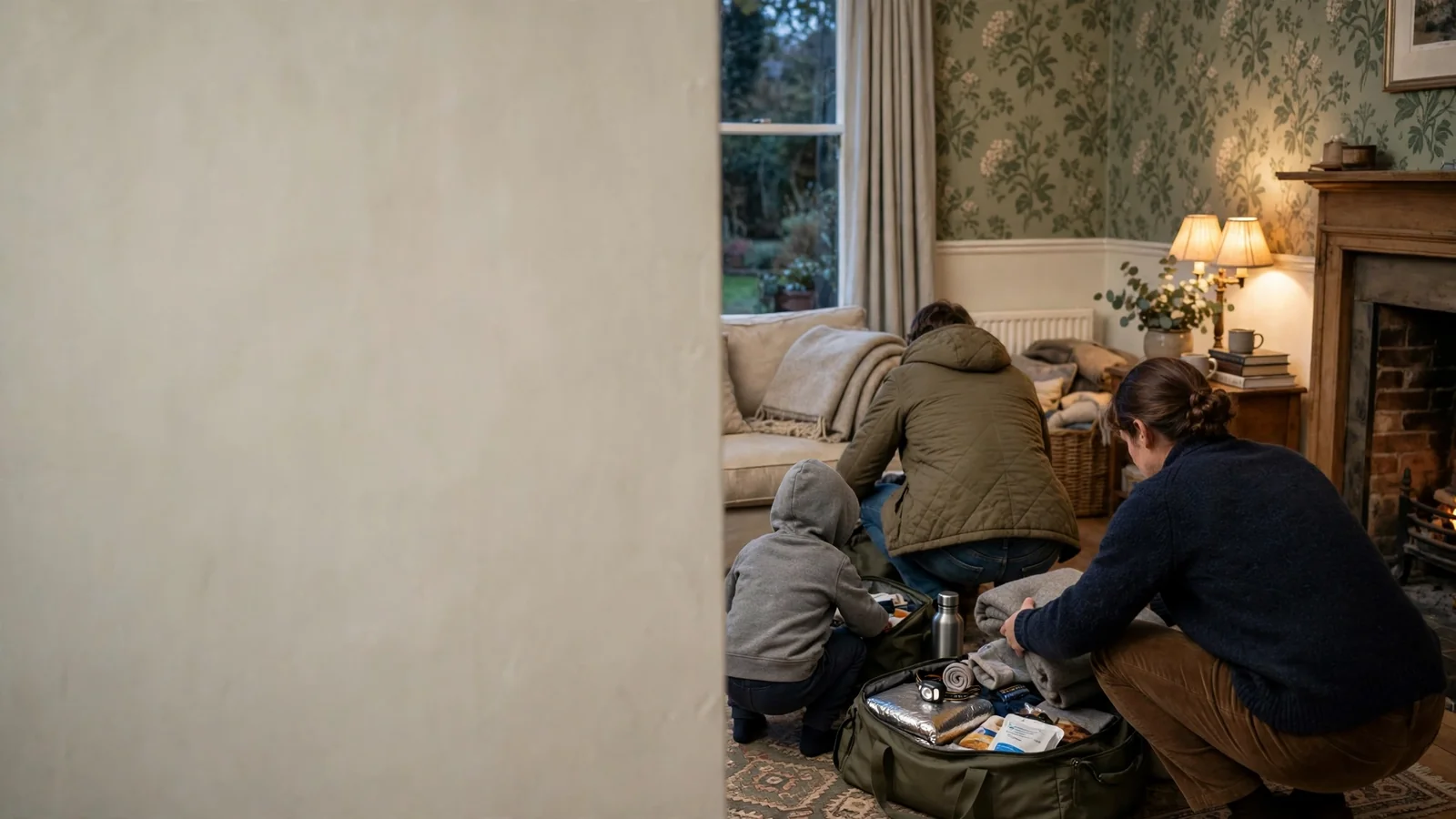
The practical advice in the campaign, as reported, is to build the kit gradually rather than buying everything in one trip. That matters for two reasons. The first is cost: a three-day supply of water, food, batteries and a radio is affordable spread over several shops, but it is a noticeable expense bought all at once, and panic buying risks emptying shelves for other people. The second is rotation: food and water expire, batteries run down, and medication changes, so a kit bought once and forgotten will not be usable when it is needed. The Netherlands' Denk vooruit campaign, launched 3 November 2025, advises checking the kit every six months, and the United States' Ready.gov guidance advises replacing stored water every six months; the same discipline applies to a British kit. A practical approach is to add a few litres of water and a few tins to each weekly shop, to keep the torch and radio where they can be found in the dark, to keep the power bank charged, and to keep copies of documents and a small amount of cash in the same place. Households with babies, pets, or people who take regular medication should add those supplies first, because they are the hardest to improvise. The campaign site, beready.campaign.gov.uk, is the place to check the current checklist, and this site will update this page if the checklist changes.
Be Ready in the wider picture
Be Ready sits in a wider picture that readers should understand in full. The European Commission's guidelines of 30 October 2026 set a minimum baseline of at least 72 hours of self-sufficiency for the European Union, and the United Kingdom's three-day advice matches that baseline even though the UK is not an EU member state. France advises a kit for the first 72 hours. Ireland's Be Emergency Ready booklet advises enough food and water to see a household through an emergency, with 2 to 3 litres of drinking water per person per day. The Netherlands advises 72 hours with 3 litres of water per person per day. Sweden, Norway and Estonia advise a week. Germany advises ideally ten days. The UK's three days is therefore the common European floor, not an outlier, and it is the floor the government chose for a campaign that is meant to reach every household. The campaign's success will not be judged by a single launch day, but by whether, over its three years, the proportion of people who feel prepared rises from the 13 per cent cited at launch. That is a slow measure, and this site will follow it as new research is published.
What the 13 per cent figure means
The figure cited at launch — that only 13 per cent of people felt prepared — is worth pausing on, because it is the clearest evidence in the research that a campaign was needed, and because it is easy to misread. It is a measure of how people feel, not a measure of what they have in their cupboards. A person can feel prepared without being prepared, and a person can be prepared without feeling it, and the survey behind the figure asked about feelings rather than counting tins of food. The figure also says nothing about why the other 87 per cent did not feel prepared: whether they had never thought about it, whether they thought it was the government's job, whether they could not afford it, or whether they thought the risks did not apply to them. The campaign's job, over three years, is to change that feeling, and the way to change it is practical: a list, a few litres of water, a torch, a radio, and the knowledge of what to do. Finland offers a useful comparison. A SPEK survey in spring 2025, of 1,000 people aged 18 to 79, found that 54 per cent said their preparedness met the 72-hour recommendation. That is a different question — whether preparedness meets a standard, rather than whether a person feels prepared — and the Finnish figure is higher, which suggests that a clear standard and a long-running programme can move the number. The United Kingdom's 13 per cent is a starting point, not a verdict, and the campaign will be judged by whether it rises over its three years.
Frequently asked questions
Be Ready is the UK Government's national preparedness campaign, launched on 22 October 2026 by the Cabinet Office as the first stage of a three-year campaign, with more than 500 organisations signed up. It advises households to keep enough water and food for three days if electricity, water, phone or internet fail.
Three litres of drinking water per person per day, which is 9 litres per person for three days, plus more for cooking and washing. The figure is as reported by the BBC, Sky and the Cabinet Office at the campaign launch on 22 October 2026.
Non-perishable food needing no cooking or fridge, 3 litres of drinking water per person per day, a torch with spare batteries, a battery or wind-up FM radio, a charged power bank, a first-aid kit and regular medication, cash, copies of documents, and supplies for babies and pets where relevant.
No. The risks named at launch were storms, flooding, power cuts, cyberattacks and hostile states, but no specific threat or date was attached to the campaign. The Cabinet Office also said there was no specific threat behind the separate Black Sky broadcasting contingency.
No. Be Ready is a public campaign telling households to keep three days of supplies. Black Sky is the BBC's emergency-broadcasting contingency for a total national grid failure, reported by the BBC on 7 November 2026. They are separate, and Black Sky is covered on its own page.
No. NATO's Resilience Baseline Requirements of 15 September 2026 are state-level requirements and never mention household kits or 72 hours. Be Ready is a United Kingdom government campaign.
Research cited at the launch found that only 13 per cent of people felt prepared. That figure was presented by the government as the reason a public-awareness campaign was needed.
On the campaign site, beready.campaign.gov.uk. The exact checklist page was not text-fetched in the research for this site, so the item list on this page is given as reported at launch and should be verified live on the campaign site.
Figures are given with their snapshot time and source. Developing items are marked as developing. Last checked Tuesday 17 November 2026, about 12:50 PKT.