How to Prepare for a Cyberattack at Home
No government in the research for this site has published a separate cyberattack home kit. What governments have published is emergency-kit guidance for any disruption — power cuts, storms, cyberattacks and hostile states are named together in the United Kingdom's Be Ready campaign — and the autumn 2026 attacks on supermarkets and refrigeration show why that general guidance matters for a cyberattack in particular. This page brings the two together: the official kit guidance, applied to a cyberattack at home, and the lessons of the attacks that actually happened, with each lesson tied to its source.
In short
Preparing for a cyberattack at home means preparing for the services a cyberattack can take away: electricity, water, phone and internet, card payments, and food distribution. The official guidance is the same emergency-kit guidance that applies to any disruption: water, long-life food, a torch, a battery or wind-up radio, a charged power bank, a first-aid kit and regular medication, cash in small notes and coins, and copies of important documents. The United Kingdom's Be Ready campaign, launched 22 October 2026, names cyberattacks among the risks its three-day kit covers. The Ahold Delhaize cyberattack of October 2026 showed that when a retailer's IT systems go down, distribution centres halt and shelves empty within days, and Erasmus University researcher Rene de Koster said on 29 October 2026 that regional distribution centres hold about 1.5 days of stock. There is no official separate cyberattack kit, and this page does not invent one.
Start with what a cyberattack can take away
A cyberattack at home is not usually an attack on a single household. It is an attack on the systems a household depends on. The Ahold Delhaize cyberattack shows the pattern. Ahold Delhaize switched off its IT systems after suspicious activity on Sunday 11 October 2026. Distribution centres halted, home deliveries were cancelled, and fresh-produce shelves emptied within days. The company's chief executive, Frans Muller, confirmed on 19 October 2026 that the incident was the malicious actions of others. A police report was filed and the NCSC, the Dutch National Cyber Security Centre, was notified within 24 hours. Erasmus University researcher Rene de Koster, of the Rotterdam School of Management, said on 29 October 2026 that regional distribution centres hold about 1.5 days of stock, enough when supplies run normally but not when the flow stops, and that ordering, distribution-centre and supplier ordering all depend on the same IT systems, so when they went down none of that could happen. Albert Heijn has four regional distribution centres, in Tilburg, Pijnacker, Zaandam and Zwolle, each supplying about 200 supermarkets. The lesson for a household is not about the retailer. It is about dependence: food, payments, communications and power all depend on digital systems, and a cyberattack on any of them can leave a household without services it normally takes for granted. Preparing for a cyberattack therefore means preparing for the loss of those services, not for a hacker in a living room.
The official kit, applied to a cyberattack
The official emergency-kit guidance applies directly to a cyberattack, because the kit is designed for any disruption in which services stop. Water is first: the Netherlands' Denk vooruit campaign advises 3 litres per person per day for 72 hours, the United Kingdom's Be Ready campaign advises 3 litres of drinking water per person per day for three days, and the United States' Ready.gov page advises one gallon, about 3.8 litres, per person per day for drinking and sanitation. Food is second: long-life food that needs no cooking and no fridge, for three days as a minimum, a week in Sweden, Norway and Estonia, and ideally ten days in Germany. Light and information are third: a torch with spare batteries, a battery or wind-up radio, and a charged power bank, because a cyberattack that takes down the internet does not take down FM radio, and a radio is the way official information reaches a household when phones and the internet do not work. Cash is fourth: cash in small notes and coins, because card machines fail when power and networks fail, as they did in Madrid during the Spain-Portugal blackout of 28 April 2025, when some shops went cash-only or gave credit to regular customers. Documents are fifth: copies of identity documents, kept on paper, because a phone that cannot be charged or a cloud account that cannot be reached is not a reliable copy. Medicines are sixth: regular medication, with Sweden advising about one month where possible and Norway advising at least seven days extra. None of these items is cyber-specific. All of them are what a household needs when digital systems stop working, whatever the cause.
Cash, paper copies and a radio: the three cyberattack essentials
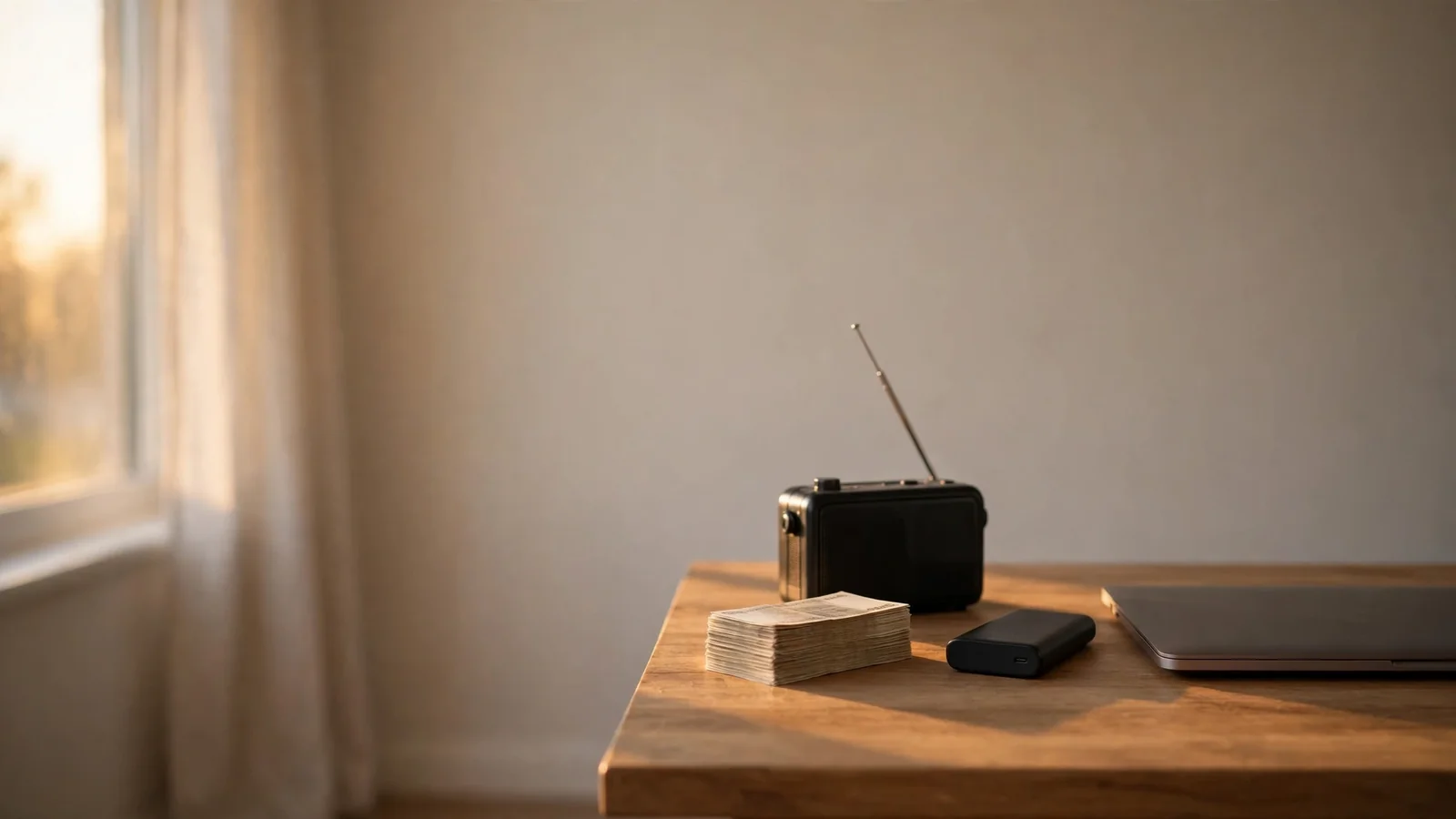
Three items deserve emphasis for a cyberattack in particular, because they are the items that replace digital services. Cash is the first. The Netherlands' Denk vooruit campaign advises about 70 euros in cash per adult and 30 euros per child, a figure from Nibud via Denk vooruit that comes through secondary summaries and needs a direct check on denkvooruit.nl before it is quoted as a direct official figure. The United Kingdom's Be Ready campaign advises cash. Belgium's guide of 1 October 2026 advises physical payment cards with remembered PINs and some cash. The reason is the same in every case: card payments depend on power and networks, and a cyberattack or a blackout can take both away. Paper copies are the second. The Netherlands advises copies of identity documents. The United Kingdom advises copies of important documents. France advises photocopies of documents and spare keys. A paper copy works when a phone is dead, a cloud account is unreachable, or a system is down. A radio is the third. The United Kingdom advises a battery or wind-up FM radio. Norway advises a battery, crank or solar DAB radio, and names NRK P1 as the emergency channel. Denmark advises FM radio, with DR broadcasting emergency announcements. Finland advises a battery radio with spare batteries. The radio is the only item in the kit whose purpose is information, and in a cyberattack it is the item that matters most, because it is the channel that does not depend on the internet. A household that has cash, paper copies and a radio can pay, can prove who it is, and can hear what the authorities are saying, even when every screen in the house is dark.
What the fridge attacks taught households
The supermarket refrigeration cyberattacks of October and November 2026 taught a second lesson, about food. In the first wave, on 11 to 12 October 2026, about 700 French stores, including Intermarche, Cooperative U, E.Leclerc and Carrefour, had refrigeration and freezer controllers forced into defrost mode overnight. Temperatures rose, food spoiled and was discarded, and there were some fires, melted equipment and sprinkler water damage. Losses were in the tens of millions of euros. CERT-FR, the French computer emergency response team, issued alerts on Danfoss controllers, the AK-SM800 and AK-SC355 models, later extended to Copeland and Dixell XWEB controllers. Danfoss said on 13 October 2026 that affected systems should be disconnected from the internet, and that most affected equipment was legacy equipment no longer receiving security updates. In the second wave, on 1 to 2 November 2026, more than 100 stores in Belgium, the Netherlands, Luxembourg, Ireland, Sweden and Estonia were affected, with problems also in Finland, Italy and Portugal, and later reports put the second wave at 13 countries. Temperatures rose to up to 50 degrees Celsius in the second wave. The EU Agriculture Commissioner, Christophe Hansen, said on 3 November 2026 that the attacks were a deliberate attempt to disrupt the food supply chain. The household lesson is about cold food. Food in a fridge or freezer depends on power and on the controllers that manage it, and a cyberattack on those controllers can spoil food that looks untouched. Long-life food that needs no fridge is in every government kit list for that reason, and a household that keeps it does not depend on refrigeration working. The attribution of the waves is covered on the attacks hub: French authorities attributed the first wave to Iran's IRGC and the Shahid Kaveh cyber unit on 9 November 2026, and the second wave was claimed on Telegram by NoName057(16) and Z-Pentest, a claim, not confirmed attribution, with no confirmed link between the waves.
Power, phones and the first hour
The first hour of a cyberattack or a blackout is the hour in which a household's preparation is tested, and the official guidance gives a clear sequence. Keep the fridge and freezer closed, so cold food stays cold for as long as possible. Charge the phone and the power bank while power is available, and keep the power bank charged as a habit, not only in a crisis. Turn on the battery or wind-up radio and find the emergency station: NRK P1 in Norway, DR on FM in Denmark, and the local FM emergency broadcasts elsewhere. Check cash and paper documents, and keep them in one place. Do not panic buy: the Netherlands' Denk vooruit campaign, the United Kingdom's Be Ready campaign and Ireland's Be Emergency Ready booklet all advise building supplies gradually, and panic buying empties shelves for other people and leaves the buyer with supplies they may not need. The Spain-Portugal blackout of 28 April 2025, at 12:33 CEST, shows what the first hour looks like in practice: about 60 million people were affected, 60 per cent of Spain's electricity supply vanished within five seconds, supermarkets closed or ran on generators, shoppers queued for canned goods, bottled water, toilet paper, torches, portable gas stoves and wind-up radios, card machines failed, and petrol stations could not pump fuel. Power was restored through the evening and night, with rural areas without power for ten to eighteen hours and some pockets for up to 24 hours. The cause is still not definitively established, and the Portuguese prime minister said there was no indication of a cyberattack. The blackout was not a cyberattack, but the household experience — no power, no cards, no fuel, no information except radio — is the same experience a cyberattack can cause, and the preparation is the same.
What not to do, and what to check
There are three things not to do. Do not treat a cyberattack as a reason to buy everything at once. The official guidance in every country is to build supplies gradually, and Ireland's booklet says so explicitly. Do not believe a viral claim that a blackout or a cyberattack is coming on a specific date. The viral claim of a 90-day global blackout starting on 17 November 2026 was found to have no evidence and rated false by PolitiFact on 16 November 2026, and no government in the research for this site says a specific attack is imminent on a specific date. Do not present a compilation as a coordinated warning. The European Commission's guidelines of 30 October 2026 are non-binding, NATO's requirements of 15 September 2026 never mention household kits, and the national campaigns are national decisions. What to check, instead, is practical and boring, which is the point. Check the kit every six months, as the Netherlands advises, and replace stored water every six months, as the United States advises. Check that the torch works, that the radio works, that the power bank holds a charge, and that the cash and paper documents are where they should be. Check the national guidance in the country where you live, because it gives the quantities, the warning systems and the risks that apply to you. And check the source of any claim before sharing it, because a false claim about a blackout causes the same panic as a real one, and the only defence is to ask who said it, when, and with what evidence.
Frequently asked questions
Prepare for the services a cyberattack can take away: electricity, water, phone and internet, card payments and food distribution. Keep water, long-life food, a torch, a battery or wind-up radio, a charged power bank, a first-aid kit and regular medication, cash in small notes and coins, and paper copies of important documents. The UK Be Ready campaign, launched 22 October 2026, names cyberattacks among the risks its three-day kit covers.
No. No government in the research for this site has published a separate cyberattack home kit. The official guidance is emergency-kit guidance for any disruption, and it applies to a cyberattack because a cyberattack takes away the same services as a power cut or a storm.
Card machines fail when power and networks fail, as they did in Madrid during the Spain-Portugal blackout of 28 April 2025. The Netherlands advises about 70 euros in cash per adult and 30 euros per child, and the UK Be Ready campaign advises cash. Cash in small notes and coins works when digital payments do not.
A battery or wind-up FM radio does not depend on the internet, so it keeps working when phones and the internet do not. Norway names NRK P1 as the emergency channel, Denmark names DR on FM, and the UK Be Ready campaign advises a battery or wind-up FM radio.
Ahold Delhaize switched off its IT systems on 11 October 2026, distribution centres halted, home deliveries were cancelled, and fresh-produce shelves emptied within days. Erasmus University researcher Rene de Koster said on 29 October 2026 that regional distribution centres hold about 1.5 days of stock, enough when supplies run normally but not when the flow stops.
Yes. Every government kit list advises long-life food that needs no cooking and no fridge. The October and November 2026 refrigeration cyberattacks forced supermarket freezers into defrost mode and spoiled food, which is why food that does not depend on refrigeration is in the guidance.
Keep the fridge and freezer closed, charge the phone and power bank, turn on the battery or wind-up radio and find the emergency station, check cash and paper documents, and do not panic buy. The official guidance in every country is to build supplies gradually, not all at once.
No government in the research for this site says a specific attack, blackout or disaster is imminent on a specific date. The viral claim of a 90-day global blackout starting on 17 November 2026 was found to have no evidence and rated false by PolitiFact on 16 November 2026.
Figures are given with their snapshot time and source. Developing items are marked as developing. Last checked Tuesday 17 November 2026, about 12:50 PKT.