Emergency Kit Checklist: What to Pack for 72 Hours (Printable)
This is the printable checklist for the Preparedness Hub: everything a household should keep for 72 hours, grouped so it can be ticked off, with the official quantities from the governments that publish them. The checklist follows the categories in the European Commission's guidelines of 30 October 2026 — food, stored water, heating and cooling, light, medicines, hygiene and toilet supplies, a way to get information, cash in small notes and coins, and an emergency grab bag — and it gives the national figures where they exist. It is a news-site checklist drawn from official guidance, not a government publication, and it does not replace the national guidance in the country where you live.
In short
For 72 hours, keep 9 litres of water per person if you follow the Netherlands or the United Kingdom, which both advise 3 litres per person per day, or 6 litres per person per day if you follow Germany's 2 litres per person per day for drinking and cooking. Keep long-life food that needs no cooking and no fridge, a torch with spare batteries, a battery or wind-up radio, a charged power bank, a first-aid kit and regular medication, cash in small notes and coins, paper copies of important documents, hygiene supplies, warm clothes, and supplies for babies and pets where relevant. Check the kit every six months, as the Netherlands advises, and replace stored water every six months, as the United States advises. The European Commission's guidelines of 30 October 2026 set no quantities and no mandatory kit; the quantities on this page come from national guidance, cited by country.
Water: how much, and how to store it
Water is the first item on every government list, and the quantities differ because they count different things. The Netherlands' Denk vooruit campaign, launched 3 November 2025, advises 3 litres of water per person per day, which is 9 litres per person for 72 hours, 21 litres for a week, and 36 litres for a family of four for 72 hours. The United Kingdom's Be Ready campaign, launched 22 October 2026, advises the same figure: 3 litres of drinking water per person per day, plus more for cooking and washing. Denmark advises 3 litres per person per day for drinking and cooking. Poland advises at least 3 litres per person per day. Sweden advises at least 3 litres per person per day, and the MCF website now says 3 to 5 litres per adult per day. Luxembourg advises at least 3 litres per person per day. Germany's BBK, in its November 2025 guide, advises 2 litres of liquid per person per day, 1.5 litres to drink and 0.5 litres for cooking, which is 6 litres per person for 72 hours and 20 litres per person for ten days. Finland advises about 2 to 3 litres of drinking water per person per day. Ireland advises 2 to 3 litres of drinking water per person per day. The United States advises one US gallon, about 3.8 litres, per person per day for drinking and sanitation, on its Ready.gov page last updated 1 July 2026. France advises 6 litres of bottled water per person in total for the kit, not per day. Canada's printed guide says 2 litres per person per day, while the current canada.ca page says about 4 litres per person per day; the difference is explained as different scopes, drinking only against drinking plus cooking plus hygiene, and this site quotes both and explains the difference rather than picking one silently. Austria's blackout guide says at least 2.5 litres per person per day, while an OZSV example list gives 21 litres for 14 days, which works out at 1.5 litres per day; the two figures do not reconcile, and this site flags the discrepancy. Store water in sealed bottles, keep it in a cool dark place, and replace it every six months, as the United States advises. The worked examples in this section are arithmetic on the stated per-day figures, not government quotes.
Food: what to keep, and how to rotate it
Food should be long-life food that needs no cooking and no fridge, because a disruption can take away power and refrigeration together. The United Kingdom's Be Ready campaign advises non-perishable food needing no cooking and no fridge, for three days. The Netherlands advises long-life food for 72 hours. Sweden advises food for a week that keeps and needs no fridge and little or no cooking. Norway advises food for a week. Denmark advises food for three days with no fridge. Germany advises shelf-stable food for ten days, and the federal food agency's Notvorrat calculator works on 2,200 kilocalories per person per day. Austria's OZSV example list works on about 2,000 kilocalories per day for fourteen days. Finland advises using everyday food kept in larger quantity, rather than a separate stockpile of special products. Ireland advises building supplies up gradually, not all at once. Japan recommends the rolling-stock method: using everyday food and replacing what is used, so the stockpile stays fresh without a separate shopping trip. A practical list is tinned food with a manual can opener, dried food such as rice, pasta and oats where cooking is possible, biscuits, dried fruit and nuts, long-life milk, and food for babies and pets where relevant. Keep the food where it can be reached in the dark, keep it dry, and rotate it: use the oldest first and replace what is used, so nothing expires unnoticed. The quantities depend on the duration you are preparing for: three days as a minimum, a week in Sweden, Norway and Estonia, ideally ten days in Germany, and fourteen days in Austria.
Light, power and information
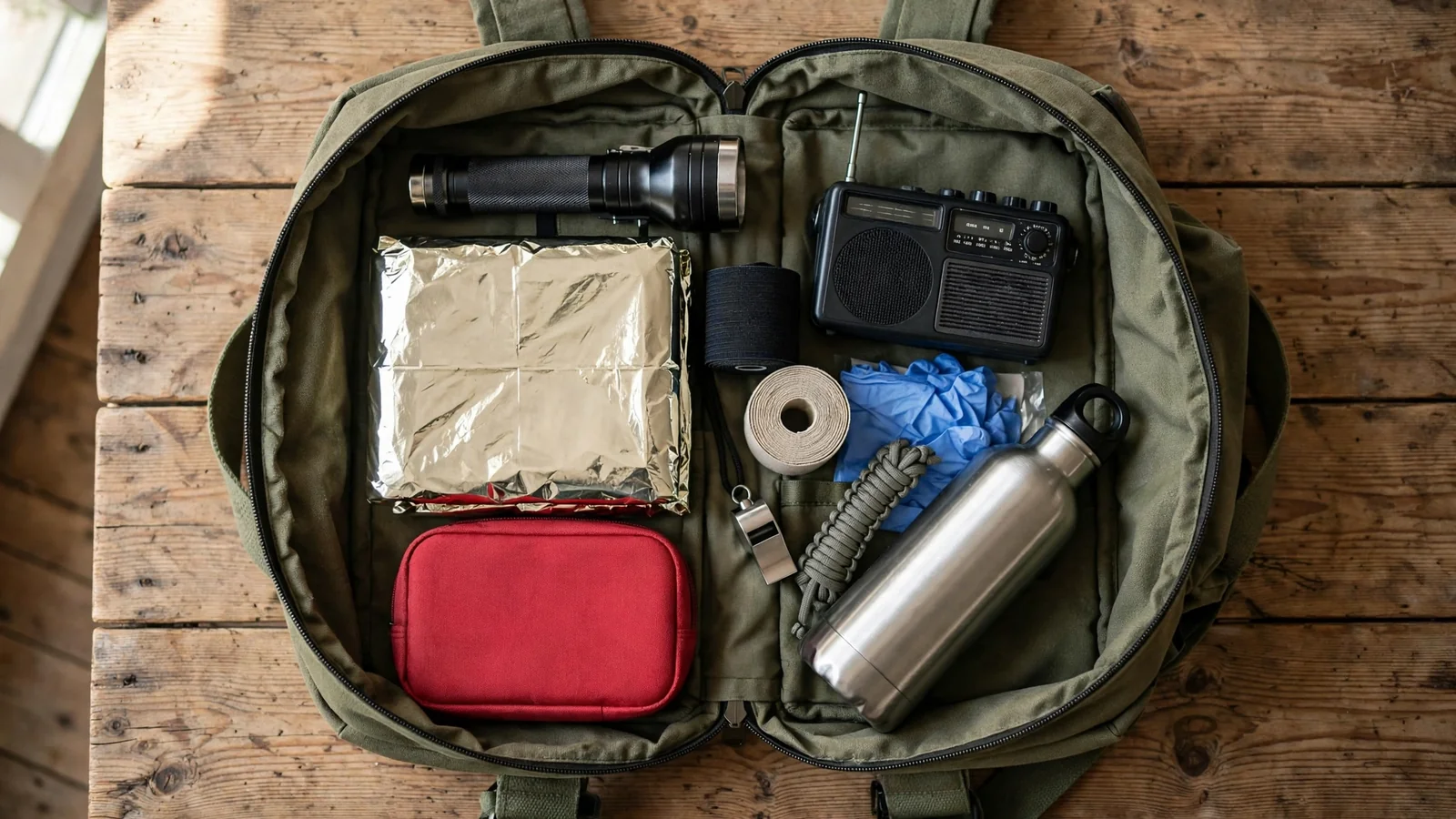
Light, power and information are the third group, and they are the group that replaces digital services when they fail. A torch with spare batteries is on every government list, including the Netherlands, the United Kingdom, Sweden, Finland, Denmark, Germany, France, Belgium and Canada. A battery or wind-up radio is on every list, and the emergency station should be known in advance: NRK P1 in Norway, DR on FM in Denmark, and the local FM emergency broadcasts elsewhere. A charged power bank is advised by the Netherlands, the United Kingdom, Denmark, Germany, Finland and others, and it should be kept charged as a habit, not only in a crisis. Spare batteries should be kept with the torch and the radio, and the batteries should be checked when the kit is checked. Candles and matches are advised by Norway, with an alternative heat source, but candles should be used with care and never left unattended. A whistle is on the United States Ready.gov list, and a dust mask, plastic sheeting and tape are also on that list. The practical test for this group is simple: can the household find the torch in the dark, can it turn on the radio and find the emergency station, and can it charge a phone from the power bank? If the answer to any of those is no, the kit is not ready, however much food and water it contains.
Health, hygiene and medicines
Health is the group that cannot be improvised. A first-aid kit is on every government list, including the Netherlands, the United Kingdom, Sweden, Denmark, France, Belgium and Canada. Regular medication should be kept in the kit, and the durations differ by country: Sweden advises prescription medicines for about one month where possible, Norway advises at least seven days of extra regular medicines, Germany advises medicines for at least ten days, Denmark advises at least three days of medication, and Belgium advises three days of medicine. Finland advises iodine tablets for ages 3 to 40 and for pregnant and breastfeeding people, on the advice of the Ministry of Social Affairs and Health. Norway advises iodine tablets for people under 40, pregnant and breastfeeding people, and children at home, on the advice of the DSA. Belgium advises iodine tablets in its guide of 1 October 2026. Hygiene and toilet supplies are in the European Commission's guidelines of 30 October 2026, and they are on the national lists too, including Denmark, Germany and Canada. The practical rule is to keep the medicines that are taken every day in the kit, to keep them in date, and to keep a written list of medicines and doses with them, because a pharmacist or a doctor who cannot reach a medical record will need the list. Households with babies, older people, or people with medical needs should add those supplies first, because they are the hardest to improvise, and Canada's Get Prepared programme explicitly advises a plan for children, older people, pets and medical needs.
Money, documents and the grab bag
Money and documents are the group that works when digital systems do not. Cash in small notes and coins is advised by the Netherlands, the United Kingdom, Sweden, France, Denmark, Belgium and Canada, and the Netherlands advises about 70 euros in cash per adult and 30 euros per child, a figure from Nibud via Denk vooruit that comes through secondary summaries and needs a direct check on denkvooruit.nl before it is quoted as a direct official figure. Belgium advises physical payment cards with remembered PINs and some cash. Copies of identity documents are advised by the Netherlands, the United Kingdom, France, Germany, Finland and Canada, and France also advises spare keys and photocopies of documents. The European Commission's guidelines of 30 October 2026 list an emergency grab bag as a category, and Germany's guide includes a grab bag called Notgepack, while Belgium's guide of 1 October 2026 advises a two-part kit made up of a grab bag and a home kit. The grab bag is the kit that leaves the house: water, food, torch, radio, power bank, first-aid kit, medicines, cash, copies of documents, warm clothes and hygiene supplies, in a bag that can be carried. The home kit is the larger stockpile that stays in the house. Keep the grab bag by the door or in a known place, keep the home kit in a cool dry place, and keep the documents and cash in the same place in both, so they can be found in the dark.
Checking, rotating and printing this list
A kit that is bought once and forgotten is not a kit. The Netherlands' Denk vooruit campaign advises checking the kit every six months. The United States' Ready.gov guidance advises replacing stored water every six months. Japan recommends rolling stock, using everyday food and replacing what is used. Finland advises using everyday food kept in larger quantity. Ireland advises building supplies up gradually, not all at once. The practical routine is to check the kit twice a year, on the same dates each year, and to tick off the list on this page. Check the water: is it in date, is it sealed, is there enough for the duration you are preparing for? Check the food: is it in date, is it the food the household actually eats, and has the oldest been used first? Check the torch, the radio and the power bank: do they work, are the batteries fresh, is the power bank charged? Check the medicines: are they in date, is there enough for the duration advised in your country, and is the written list of medicines and doses with them? Check the cash and the documents: is the cash still there, are the copies current, and are they in the same place? Print this page, keep it with the kit, and tick each item off as it is checked. The checklist is drawn from official guidance, and it does not replace the national guidance in the country where you live, which gives the quantities, the warning systems and the risks that apply to you.
Frequently asked questions
Water, long-life food that needs no cooking and no fridge, a torch with spare batteries, a battery or wind-up radio, a charged power bank, a first-aid kit and regular medication, cash in small notes and coins, paper copies of important documents, hygiene supplies, warm clothes, and supplies for babies and pets where relevant.
On the Netherlands and UK figure of 3 litres per person per day, a family of four needs 36 litres for 72 hours. On Germany's figure of 2 litres per person per day, the same family needs 24 litres. On the US figure of one gallon, about 3.8 litres, per person per day, it needs about 45 litres. These are arithmetic on the stated per-day figures, not government quotes.
Every six months, according to the Netherlands Denk vooruit campaign, and stored water should be replaced every six months, according to the US Ready.gov guidance. Japan recommends rolling stock, using everyday food and replacing what is used, so the stockpile stays fresh.
The grab bag is the kit that leaves the house: water, food, torch, radio, power bank, first-aid kit, medicines, cash, copies of documents, warm clothes and hygiene supplies, in a bag that can be carried. The home kit is the larger stockpile that stays in the house. Belgium's guide of 1 October 2026 advises a two-part kit of this kind, and Germany advises a grab bag called Notgepack.
The Netherlands advises about 70 euros in cash per adult and 30 euros per child, a figure from Nibud via Denk vooruit that comes through secondary summaries and needs a direct check on denkvooruit.nl. The UK Be Ready campaign advises cash, and Belgium advises physical payment cards with remembered PINs and some cash. Keep cash in small notes and coins.
Sweden and Norway advise food for a week, Germany advises shelf-stable food for ideally ten days, and Austria advises food for fourteen days. Germany's federal food agency works on 2,200 kilocalories per person per day, and Austria's OZSV list works on about 2,000 kilocalories per day. Use the rolling-stock method: use everyday food and replace what is used.
Regular medication, kept in date, with a written list of medicines and doses. Sweden advises prescription medicines for about one month where possible, Norway advises at least seven days extra, Germany advises at least ten days, and Denmark and Belgium advise three days. Iodine tablets are advised in Finland, Norway and Belgium for the groups named in their guidance.
Keep the grab bag by the door or in a known place where it can be found in the dark, and keep the home kit in a cool dry place. Keep the torch, radio and power bank where they can be reached without light, and keep cash and paper documents in the same place in both the grab bag and the home kit.
Figures are given with their snapshot time and source. Developing items are marked as developing. Last checked Tuesday 17 November 2026, about 12:50 PKT.