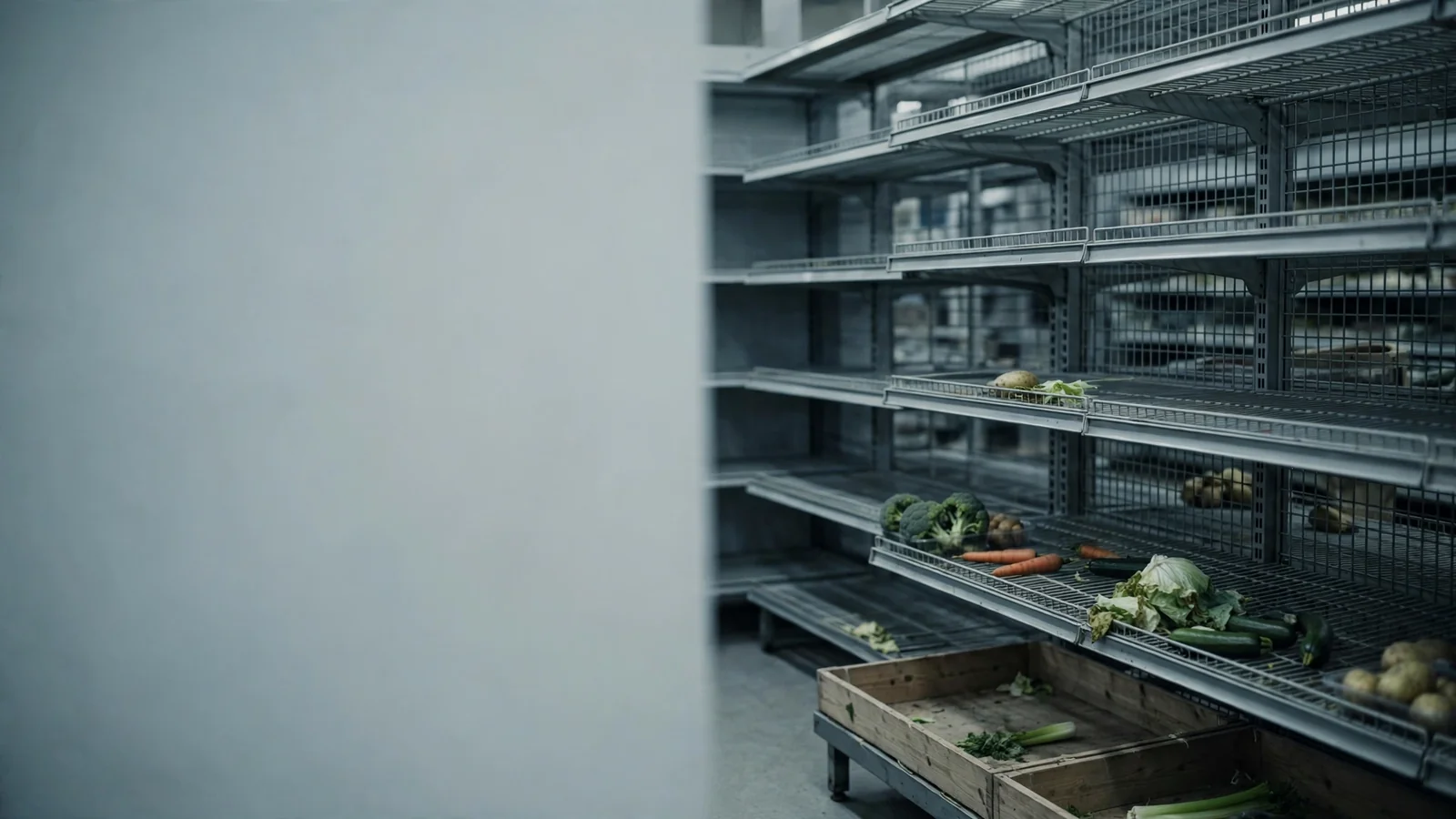
Albert Heijn: How Shelves Emptied in Days
On Sunday 11 October 2026, Ahold Delhaize detected suspicious activity in its IT systems and switched them off. Within days, Albert Heijn shelves were emptying — fresh fruit and vegetables first. The stores themselves never closed, and the tills kept working. What failed was the invisible machinery behind the shelves: ordering, distribution centres and home delivery. This page explains the mechanics of how shelves emptied, step by step. For the day-by-day chronology of the incident itself, see our full timeline page.
In short
Albert Heijn shelves emptied because the company's IT systems were switched off, and the food chain behind the shelves runs on those systems. Regional distribution centres hold only about a day and a half of stock, according to Erasmus University researcher René de Koster on 29 October 2026, so once deliveries stopped, the stock ran out quickly. Ordering, distribution-centre operations and supplier ordering all depend on the same IT systems, and when they went down none of that could happen. Fresh produce was hit first because it turns over fastest and cannot be stored. Physical stores stayed open and tills worked throughout, but home deliveries were suspended until at least 20 October 2026 and all delivery orders up to and including 22 October were cancelled. Attribution: the company confirmed on 19 October 2026 that the incident resulted from the malicious actions of others. It has not named an attacker and has not said it was ransomware.
The shutdown decision: Sunday 11 October 2026
The incident began on the afternoon of Sunday 11 October 2026, when Ahold Delhaize detected suspicious activity in its IT infrastructure and took systems offline as a precaution. That decision is the key to everything that followed. Switching systems off is the standard defensive response to a suspected intrusion: it stops an attacker moving further through the network, but it also stops the business processes that run on those systems. In this case the affected systems included the logistics systems that move food from suppliers to distribution centres and from distribution centres to shops, the websites and apps of Albert Heijn, Etos and Gall & Gall, customer service, and online grocery ordering. The company issued a press release at 08:29 CEST on Monday 12 October 2026 saying it was experiencing a security issue within its network, was taking some systems offline, and that stores were open and serving customers. That last point matters: this was not a story about shops closing. It was a story about the supply line behind open shops being cut.
The distribution centres stop
Albert Heijn has four regional distribution centres — in Tilburg, Pijnacker, Zaandam and Zwolle — each supplying about 200 supermarkets. On Monday 12 October 2026, work stopped completely in some of them. Albert Heijn chief executive Margaret Versteden-van Duijn told NOS that day that work had stopped completely in some distribution centres and that fresh produce was hardest hit. By the evening of 12 October, work was at a standstill in multiple distribution centres, with only Zaandam still operating, according to a supplier email obtained by RTL Z, and suppliers were told to deliver to Zaandam only. The distribution centres restarted during Wednesday 14 October 2026, with shelf-stable products returning first and fresh food taking longer. The two-day halt does not sound long, but in a system built around daily deliveries it is a long time. A distribution centre that does not move food for two days creates a gap that takes days to fill, because the food that should have arrived on Monday arrives on Wednesday, the food that should have arrived on Tuesday arrives on Thursday, and the backlog compounds.
Why a day and a half of stock runs out so fast
The figure that explains the speed is the stock level. Regional distribution centres hold about a day and a half of stock, according to René de Koster of Erasmus University's Rotterdam School of Management, speaking on 29 October 2026. His words are worth quoting in full: the stock is enough when supplies are running normally, but as soon as that flow stops, the stock runs out quickly. The reason is that ordering, distribution-centre operations and supplier ordering all depend on the same IT systems, so when they went down, none of that could happen. A typical Dutch supermarket chain holds about one week's stock of an individual item, according to trade reporting, but that is an average across all products, including long-life goods that sit on shelves for weeks. Fresh food turns over in days. Researchers warn shelves can empty within two to three days after a cyberattack on logistics, according to Radboud University research reported in 2026. De Koster argues supermarkets should hold a month's stock of a selection of important products. That is his recommendation, not policy, and no such obligation exists today.
Fresh food first: why fruit and vegetables vanished
Not all shelves emptied at the same rate, and the pattern tells you how the system works. Fresh produce — fruit and vegetables — was hardest hit, because it has the shortest shelf life, the fastest turnover and the least room for delay. A crate of apples that should have been delivered on Monday cannot wait until Thursday: it spoils, or it is sold elsewhere, or it never leaves the supplier. Shelf-stable products — tins, pasta, rice, long-life milk — came back first when the distribution centres restarted on 14 October, because they could wait and because they could be moved in bulk once the systems were back. Fresh food took longer because the whole cold chain had to be rebuilt: suppliers, lorries, chilled warehouses and shop fridges all had to be in step again. The chief executive's warning on 12 October captured the logic exactly: shelves would empty if the disruption went on longer. They did, and the emptiest shelves were the fresh ones.
The shops stayed open — and the tills worked
One fact is often lost in retellings of this story: Albert Heijn's physical stores stayed open throughout, and the tills worked. Customers could still walk in and buy what was on the shelves. What they could not do was order online, because the websites and apps and the home delivery service were down, and what they could not buy was the food that had not arrived. Home delivery was suspended until at least Tuesday 20 October 2026, according to Albert Heijn statements reported on 16–17 October, and all delivery orders up to and including Thursday 22 October were later cancelled. Deliveries resumed gradually from Friday 23 October 2026, and the website and the Mijn AH app came back online from about 19 October. The distinction matters for preparedness: a cyberattack on a supermarket does not necessarily close the shop. It can leave the doors open and the shelves empty, which is a different problem and needs a different response — a household stock of long-life food, rather than a plan to shop somewhere else on the same day.
The money: what the incident cost
On 4–5 November 2026, Ahold Delhaize estimated the impact on the fourth quarter of 2026 at 200 to 250 million euros in lower net sales and 75 to 100 million euros in lower operating result, and lowered its guidance for 2026. A controlled relaunch of certain systems was under way by 5 November. Those figures measure lost sales and lost profit, not the cost of the response or the cost to suppliers and customers, and they cover one quarter only. They also show the scale of the disruption in commercial terms: a two-day halt in distribution centres and a two-week disruption to home delivery cost a company of this size hundreds of millions of euros. The incident also had a legal dimension. The Dutch Cyberbeveiligingswet, the Cybersecurity Act, came into force on 15 August 2026, and the incident had to be reported to the Dutch National Cyber Security Centre within 24 hours — which the company did. The incident was one of the first major tests of the new law, according to NOS reporting of 16 October 2026. Since 15 August 2026 the Critical Entities Resilience Act has also been in force.
What the incident did not mean
Three things the incident did not show are as important as what it did. First, food security itself was not endangered. CBL director Marc Jansen said on 15 November 2026 that the Albert Heijn incident was a warning, that food security itself was not endangered, but that it showed how fast problems can arise. Second, the incident has not been linked to the supermarket freezer attacks. Dutch authorities see no connection between the Ahold Delhaize incident and the refrigeration-controller attacks of October and November 2026, and the company has explicitly said nothing linking the two. Third, no data theft has been established. The company said on 13 October 2026 that there was no evidence at that point that customer, associate or partner data had been taken, and repeated on 19 October that there was still no evidence sensitive data was taken. Whether any data was stolen remains open, because the investigation is ongoing. The company has also not said the incident was ransomware, has not named an attacker, and has not confirmed or denied a ransom demand. Outside experts have called an attack very likely, but that is their assessment, not the company's statement. For the full day-by-day chronology, including the police report filed on 19 October 2026, see our Albert Heijn cyberattack timeline.
Frequently asked questions
Within days of Sunday 11 October 2026, when Ahold Delhaize switched its IT systems off. By Monday 12 October, work had stopped in some distribution centres and the chief executive was warning that shelves would empty if the disruption went on longer. Fresh produce was hardest hit first.
Because fresh food has the shortest shelf life and the fastest turnover. It cannot wait for a delayed delivery, and the whole chilled chain has to be in step. Shelf-stable products returned first when distribution centres restarted on 14 October 2026; fresh food took longer.
About a day and a half, according to Erasmus University researcher René de Koster on 29 October 2026. That is enough while supplies run normally, but as soon as the flow stops, the stock runs out quickly. A typical chain holds about a week of an individual item on average, but that includes long-life goods.
No. Physical stores stayed open throughout and the tills worked. What stopped was the supply line behind the shelves: distribution centres, ordering and home delivery. Customers could buy what was on the shelves, but the shelves were not being refilled.
Not as far as has been established. The company said on 13 October and again on 19 October 2026 that there was no evidence at that point that customer, associate or partner data had been taken. Whether any data was stolen remains open because the investigation is ongoing.
The company estimated on 4–5 November 2026 that the fourth quarter of 2026 would see 200 to 250 million euros in lower net sales and 75 to 100 million euros in lower operating result, and it lowered its 2026 guidance. Those figures cover lost sales and profit in one quarter only.
Gradually from Friday 23 October 2026. Home delivery had been suspended until at least Tuesday 20 October, and all delivery orders up to and including Thursday 22 October were later cancelled. The website and the Mijn AH app came back online from about 19 October 2026.
No connection has been established. Dutch authorities see no connection between the Ahold Delhaize incident and the refrigeration-controller attacks of October and November 2026. The two incidents happened in the same month, but publicly available information does not connect them.
Figures are given with their snapshot time and source. Developing items are marked as developing. Last checked Tuesday 17 November 2026, about 12:50 PKT.