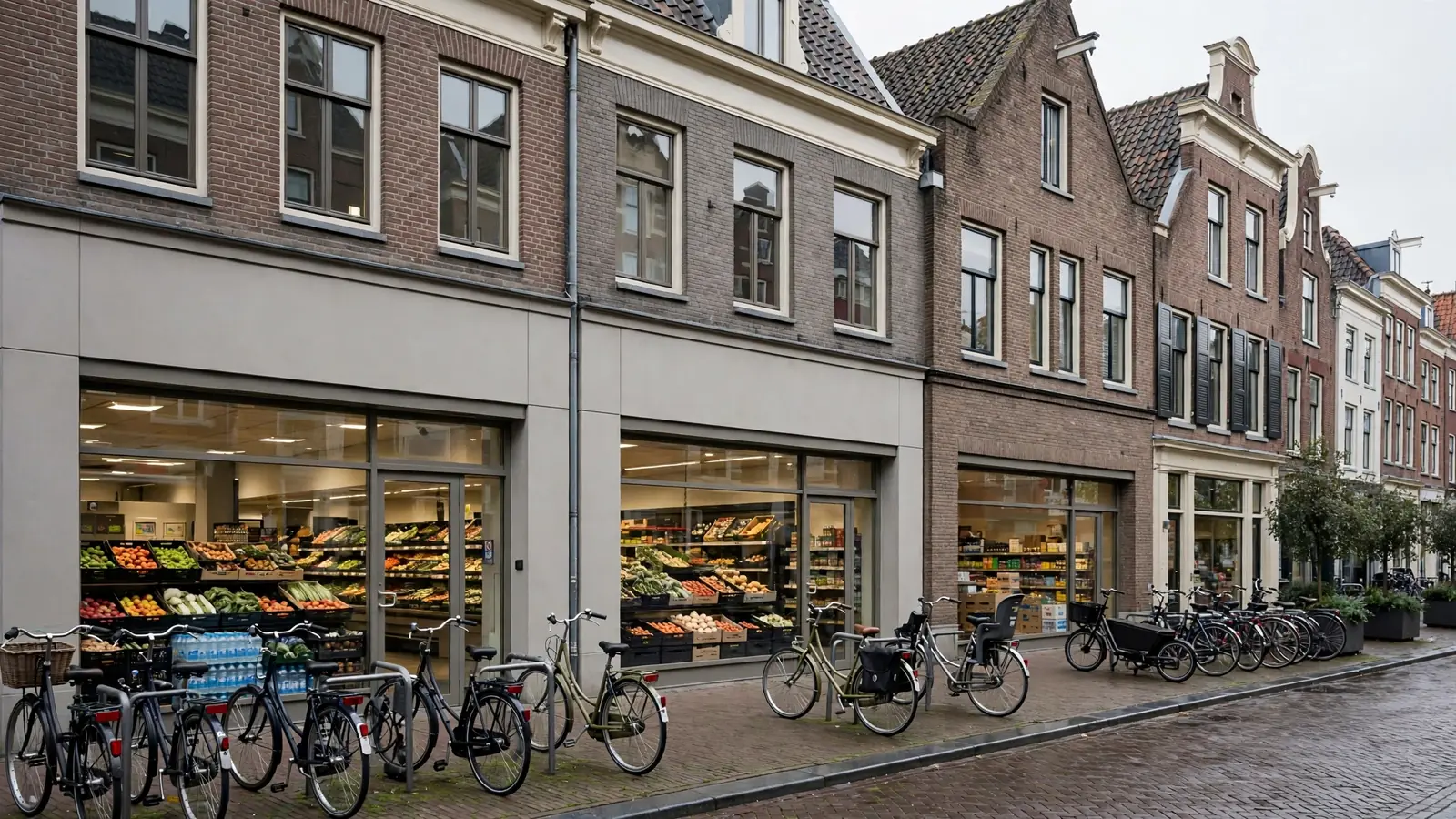
Which Supermarkets Are Involved? Albert Heijn, Jumbo, Aldi — and the Lidl Question
Three supermarket chains are named in the reporting on the noodwinkel plan: Albert Heijn, Jumbo and Aldi. A fourth name, Lidl, appears in one summary and nowhere else in the sourcing this site could verify. No individual store has been named, no town has been named, and no list of noodwinkel locations exists. This page sets out exactly which chains are confirmed, which name is unconfirmed, and why a store list cannot exist yet.
In short
The chains named in the noodwinkel reporting are Albert Heijn, Jumbo and Aldi. They were named in the Het Financieele Dagblad reporting of 31 October 2026, summarised by DutchBrief, and the same three names appear in the AD-derived coverage of 15 November 2026. Lidl is named alongside them in only one summary — Slimmekrant, 31 October 2026 — and is not named in the FD-derived or AD-derived coverage, so this site treats Lidl's participation as possible but unconfirmed (DEVELOPING). No individual store, town or region has been named as a noodwinkel, because which stores will be designated has not been decided; a final decision is expected before summer 2027. Any published list of noodwinkel locations would be invented.
The three confirmed names
The reporting is consistent on three chains. Het Financieele Dagblad's first report of the emergency-shop plan, on 31 October 2026, named Albert Heijn, Jumbo and Aldi as the chains involved, according to DutchBrief's summary of the FD piece published the same day. The AD-derived coverage of 15 November 2026 names the same three chains. The three are the natural participants: Albert Heijn is the Netherlands' largest supermarket chain and part of Ahold Delhaize, the group whose October 2026 cyber incident helped trigger the plan; Jumbo is the second-largest chain; Aldi is a major discounter with a large network of stores. Together they cover a large share of the country's roughly 4,500 supermarkets and, between them, most towns of any size. Their participation also makes logistical sense: the plan's distance target — every resident within a 15-minute drive of a noodwinkel — can only be met by chains with national coverage, and the plan's analogue-supply requirement — chains supplying each other without their usual computer systems — only matters if more than one chain is involved. The three names should still be read with care. Being named in the reporting means the chain is part of the talks, not that any of its stores has been designated. The talks have been going on for about six months, with CBL and the Ministry of Agriculture, and the designation of individual stores is one of the decisions that has not been made.
The Lidl question (DEVELOPING)
Lidl's position is the one genuinely uncertain fact on this page, and it is worth explaining why. One summary, Slimmekrant on 31 October 2026, names Lidl alongside Albert Heijn, Jumbo and Aldi. The FD-derived DutchBrief summary and the AD-derived coverage name only the three. No other source in the research for this site names Lidl as a participant. That leaves three possibilities, and the evidence does not distinguish between them: Lidl may be part of the talks and the other summaries simply did not name it; Lidl may have been named in error by one summary; or Lidl may be involved in a different capacity — for example, in the wider food-security discussions — and have been folded into the noodwinkel story by mistake. This site does not resolve the question by guessing. Lidl is treated here as possible but unconfirmed, marked DEVELOPING, and will be updated when a second independent source confirms or rules out its participation. Readers should be wary of coverage that lists four chains as settled fact on the basis of a single summary: the sourcing does not support that. The same caution applies to any other chain name that appears in social-media discussion of the story. As of 17 November 2026, no indexable Reddit thread or public Facebook post on fase zwart or noodwinkels was found in the research, so claims about what other chains are supposedly doing, sourced to social media, should be treated as unverified.
Why Albert Heijn is central to the story
Albert Heijn is central to the noodwinkel story for two reasons, one structural and one historical. Structurally, it is the largest chain, so any national network of emergency shops needs its stores: a 15-minute-drive target cannot be met in many towns without an Albert Heijn. Historically, it is the chain that lived through the incident that helped trigger the plan. In October 2026, its parent company Ahold Delhaize detected suspicious activity in its IT infrastructure, took systems offline, and saw distribution centres stop work, shelves empty and home deliveries suspended for days. The company's own statements, and the reporting that followed, made the vulnerability concrete for the whole sector: the largest chain, with the most resources, could be stopped by a failure in its digital systems. Albert Heijn's Incident Management Team chair, Ruud Limmen, was also the source for two of the most-quoted facts in the FD reporting — that the average power cut in the Netherlands lasts about 1.5 hours, and that only a handful of Dutch supermarkets have an emergency generator. That gives Albert Heijn a double role in the story: it is both a participant in the plan and, through its October experience, part of the reason the plan exists. None of that means Albert Heijn stores will be the noodwinkels, or that they will be the majority of them. The designation has not happened, and the plan's own logic — denser coverage in cities, sparser in the countryside, no stores inside enclosed shopping centres — will shape the choice more than brand.
Jumbo and Aldi: what we know
Less is reported about Jumbo and Aldi individually than about Albert Heijn, and this site does not fill the gap with invention. What is known is that both are named as participants in the FD and AD-derived reporting, and that both are part of the talks with CBL and the Ministry of Agriculture that have been going on for about six months. Jumbo, as the second-largest chain, brings a large network of larger stores, many of them freestanding rather than inside shopping centres — the kind of store the plan favours. Aldi brings a network of smaller, simpler stores, which may be easier to run on a limited essential assortment and a generator, but which also have less storage space — and storage is one of the undecided questions. Beyond that, the reporting does not distinguish between the chains' roles, and this site does not either. There is no verified reporting, as of 17 November 2026, of any chain announcing its own noodwinkel programme, publishing its own store list, or committing a specific number of stores. The plan is a joint sector plan led by CBL, not a set of competing company announcements, and the public record reflects that: the statements come from CBL's director, Marc Jansen, not from the individual chains.
Smaller retailers: the other track
The big chains are not the whole story. Independent retailers are also working on "noodscripts" — emergency scripts — with the ministries of Economic Affairs, Defence and the NCTV, for three scenarios: a large-scale power outage, a climate disaster and war. That reporting comes from FAQTS on 15 November 2026, quoting Vakcentrum spokesperson Patricia Hoogstraaten, who noted that many small shops cannot afford generators. It is a single secondary summary, so this site marks it as such, but it matters for two reasons. First, it shows the noodwinkel idea is not confined to the big three: the whole food retail sector, including independents, is thinking about the same failure. Second, it shows the cost problem at its sharpest. A generator for a large supermarket is expensive; for a small independent shop it may be unaffordable, which is why the financing question — who pays — matters beyond the big chains. The independent track is separate from the CBL noodwinkel plan, with different ministries and different scenarios, and the two should not be conflated. But they share a premise: in a prolonged crisis, the shop on the corner matters as much as the distribution centre, and it needs to be able to open without power and without computers.
No store list exists — and why that matters
The most important fact on this page is a negative one: no list of noodwinkel locations exists. No store has been named, no town has been named, no region has been named. The reason is not secrecy; it is that the decision has not been made. Which stores will be designated, how many there will be, and how the regions they serve will be drawn are all undecided, and the final decision is expected before summer 2027. Any website, social-media post or forwarded message that lists noodwinkel locations — "your nearest noodwinkel is…" — is inventing them. That matters because a false list is worse than no list: it sends people to the wrong shop in a crisis, or reassures people who live far from any real emergency shop that they are covered. The honest position, as of 17 November 2026, is that the network is a target (15 minutes by car, 30 minutes by bicycle) and a set of design rules (freestanding stores, generators, essential food only, analogue supply), awaiting the decisions that would turn it into addresses. This page will be updated when those decisions are announced — by CBL, by the Ministry of Agriculture, or by the chains themselves — and the update will say who announced it and when.
Frequently asked questions
Albert Heijn, Jumbo and Aldi are the chains named in the FD reporting of 31 October 2026 and the AD-derived coverage of 15 November 2026. Those three names are confirmed by multiple independent outlets.
DEVELOPING — possible but unconfirmed. Only one summary, Slimmekrant on 31 October 2026, names Lidl alongside Albert Heijn, Jumbo and Aldi. The FD-derived and AD-derived coverage name only the three. This site will update when a second independent source confirms or rules it out.
None has been named. Which stores will be designated has not been decided, and no list of stores or towns exists. A final decision is expected before summer 2027.
Not decided, as of 17 November 2026. No chain has announced a number of stores, and the total number of noodwinkels has not been decided.
Independent retailers are working on separate 'noodscripts' (emergency scripts) with the ministries of Economic Affairs, Defence and the NCTV, according to FAQTS on 15 November 2026. Many small shops cannot afford generators, according to Vakcentrum spokesperson Patricia Hoogstraaten.
There is no answer yet, because no noodwinkel has been designated. The target is that every resident will be within a 15-minute drive, or 30 minutes by bicycle, of one — but no list of locations exists, and any list published now would be invented.
It is the largest chain, so any national network needs its stores, and it is the chain whose parent company, Ahold Delhaize, suffered the October 2026 cyber incident that helped trigger the plan.
No, as of 17 November 2026. The plan is a joint sector plan led by CBL, and the public statements come from CBL director Marc Jansen, not from the individual chains.
Figures are given with their snapshot time and source. Developing items are marked as developing. Last checked Tuesday 17 November 2026, about 12:50 PKT.