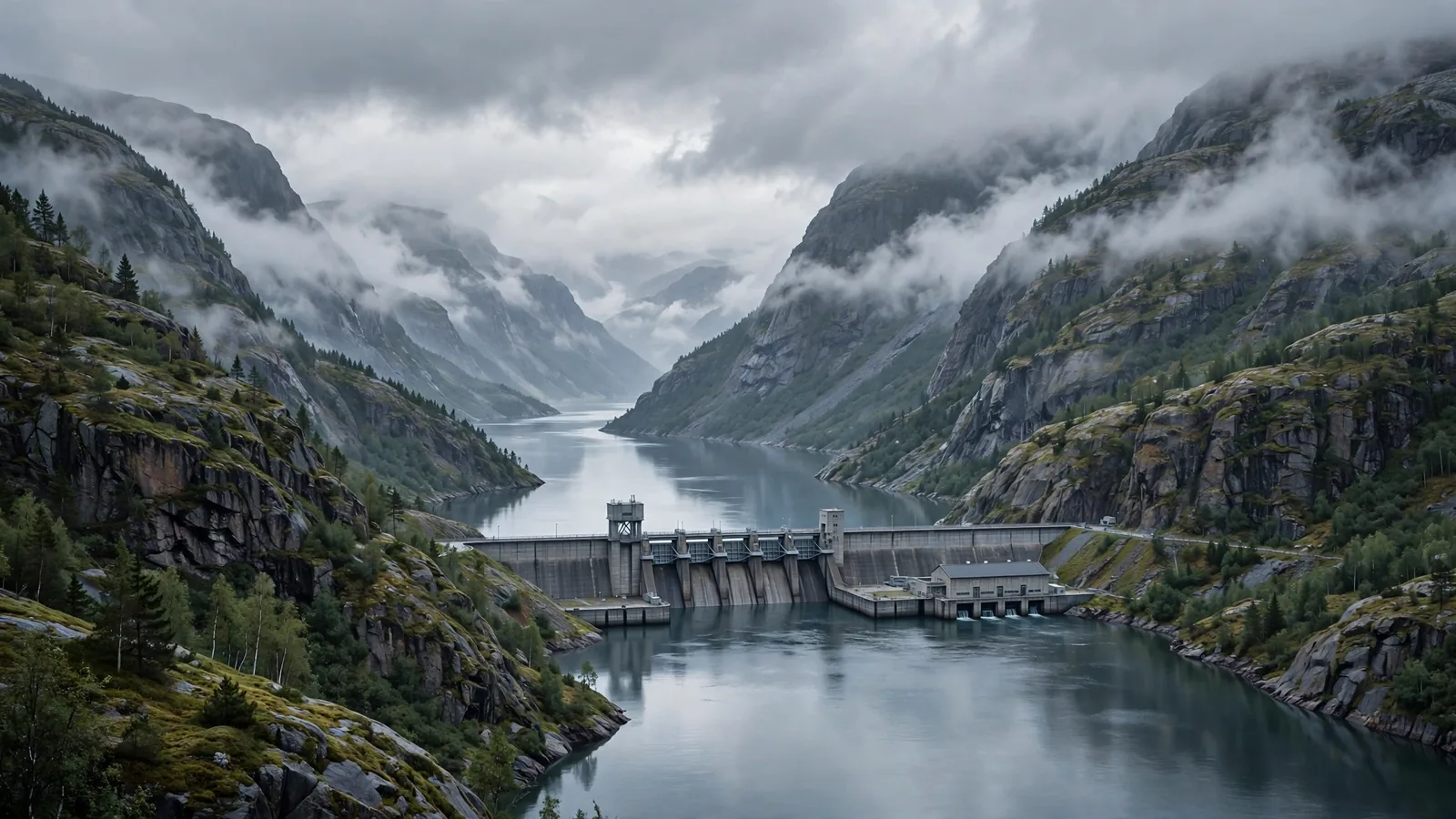
Norway: The Dam Hack — Bremanger, 7 April 2025
On the morning of 7 April 2025, attackers logged into the control system of a dam in western Norway using a weak password, opened a floodgate, and released 500 litres of water a second for about four hours before operators noticed and shut it down. Nobody was hurt, nothing flooded, and the water levels were low. The damage was not physical. It was the proof that a dam — the kind of infrastructure people assume is protected by concrete and isolation — could be opened from the internet by anyone who guessed a password. Four months later, Norway's spy chief blamed Russian hackers.
In short
Attribution: Official — Russian / Russia-linked hackers, blamed publicly on 13-14 August 2025 by Beate Gangas, head of the Norwegian Police Security Service (PST). The specific Russian group was NOT named; authorities said they were not sure which Russian cyber group was responsible, and the Russian Embassy denied involvement. On the morning of 7 April 2025, Central European Time, attackers logged into a publicly accessible web-based Human-Machine Interface (HMI) controller at the Risevatnet dam in Bremanger, Vestland, western Norway, using a weak (possibly default) password. They opened a floodgate and released 500 litres of water per second for about four hours — about 7.2 million litres, roughly three Olympic swimming pools — before operators noticed and shut it down. A pro-Russian group (Z-Alliance, per secondary reporting) posted a 3-minute video of the HMI control panel, watermarked with its logo, on Telegram the same day. There were no injuries, no flooding and no significant damage, because water levels were low. Norwegian authorities called it a demonstration of capability and hybrid warfare.
What happened on the morning of 7 April 2025
Attribution: Official — Russian / Russia-linked hackers (PST, 13-14 Aug 2025); specific group not named. The target was the Risevatnet dam at Bremanger in Vestland, western Norway — a hydropower and flood-management dam. On the morning of 7 April 2025, attackers logged into the dam's web-based Human-Machine Interface controller. The HMI was publicly accessible from the internet, and the password was weak — possibly a default password that had never been changed. With that access, the attackers opened a floodgate. Water flowed out at 500 litres per second for about four hours, around 7.2 million litres in total, before operators noticed and shut the gate down.
The same day, a pro-Russian group — Z-Alliance, according to secondary reporting — posted a 3-minute video of the HMI control panel, watermarked with its logo, on Telegram. The video was the calling card: proof that the group had been inside the control system, published for others to see. The incident was not disclosed publicly until August 2025, when the attribution was announced. The four-month gap between the attack and the disclosure is normal for incidents involving critical infrastructure: operators and intelligence services need time to investigate, to check whether other systems were affected, and to decide what can safely be said in public.
How a password opened a dam
The method was the simplest in this entire hub. There was no zero-day vulnerability, no sophisticated malware, no months-long intrusion. The dam's control panel was on the internet, and its password was weak. Anyone who found the panel and guessed the password could open the floodgate. That is not a failure of advanced security. It is a failure of the most basic security there is: do not put an industrial control system on the public internet, and do not leave its password as the default.
The same failure appears elsewhere in this hub. The French supermarket refrigeration controllers were internet-reachable with default credentials. The US water-system PLCs attacked in July 2026 were internet-exposed. The pattern is consistent across countries and sectors: operational technology that was designed for a closed network has been connected to the internet — for remote monitoring, for convenience, for cost — without the access controls that the internet requires. The Bremanger dam is the clearest example because the consequence is so easy to picture: a floodgate, opened by a password, releasing millions of litres of water. The only reason it did not cause a flood is that water levels happened to be low that day.
Why the damage was limited — and why that does not matter
There were no injuries, no flooding and no significant damage. The water levels in the reservoir were low, the release was noticed after about four hours, and the operators shut the gate down. By any measure of physical harm, the attack failed. But measuring it by physical harm misses the point, and the Norwegian authorities did not make that mistake. They called it a demonstration of capability and an act of hybrid warfare. The message of the attack was not the water that was released. It was the proof that the gate could be opened at all — and, by implication, that it could be opened again, at a different dam, at a time when water levels were high and the consequences would be a flood.
That is the logic of demonstration attacks. They are designed to be seen, not to cause maximum damage. The Telegram video is part of the attack, not an afterthought: it proves the access, advertises the capability, and forces the target government to respond publicly. The cost to the attacker was minimal — a weak password and a few hours — and the cost to Norway was a public admission that a dam could be opened from the internet. The same logic applies to other demonstration attacks in this hub, including the Polish power-grid wiper, which was stopped before it caused a blackout but still proved the attackers could get in.
The attribution: Norway names Russia
Attribution: Official, as stated above. On 13-14 August 2025, Beate Gangas, head of the Norwegian Police Security Service (PST), publicly blamed Russian / Russia-linked hackers for the dam attack. It was the first formal Norwegian attribution of a cyberattack to Russia, and it was made by the head of the security service, not by a minister or a press officer. The specific Russian group was NOT named: the authorities said they were not sure which Russian cyber group was responsible. The Russian Embassy denied involvement.
The attribution is official but limited. It names a country and a linkage — Russian hackers — without naming a unit, a group or an individual. That is a deliberate choice, and it reflects the evidence: the PST was confident enough to blame Russia, but not confident enough, or not willing, to name the group. Readers should not fill that gap themselves. No source checked names a specific group as the perpetrator, and the Z-Alliance video is a claim of involvement by a pro-Russian group, not an official attribution of responsibility for the intrusion itself. The two should not be conflated.
What Norway changed after Bremanger
The dam attack was disclosed in August 2025 alongside a broader Norwegian debate about the security of small-scale critical infrastructure. Dams, water systems and local power plants are often operated by small organisations with limited cyber-security budgets, and their control systems were often installed years ago, before internet exposure was a consideration. The Bremanger dam's HMI was publicly accessible because nobody had asked whether it should be — a question that is now asked routinely in Norway and across Europe.
Norway's preparedness guidance, covered on the Nordic preparedness page in this site's preparedness hub, already told citizens to be self-sufficient for a week — the longest official guidance in Europe. The dam attack gave that guidance a concrete illustration: the systems that manage water and power can be reached from the internet, and the people who reach them do not need sophisticated tools. The fix is also concrete and inexpensive: take control panels off the public internet, change default passwords, and require strong authentication for remote access. None of that requires new technology. It requires someone to do it.
The dam in the wider picture
Bremanger is the smallest incident in this hub by physical impact and one of the most important by implication. It is the only incident in which attackers directly operated a piece of physical infrastructure — opening a gate — rather than encrypting data or switching off a system. It proves that the boundary between cyber and physical is not a metaphor. A password opened a floodgate. The same boundary-crossing appears in the French fridge attacks, where a remote command started fires, and in the Polish wiper attack, where malware was meant to stop heating in sub-zero weather. In each case, the digital attack had a physical consequence.
That is why this incident is listed alongside the power-grid and water-system attacks rather than with the data breaches. Change Healthcare stole data from 190 million people and caused enormous harm, but it did not open a floodgate. Bremanger opened a floodgate and harmed nobody — yet it is the more alarming of the two for anyone thinking about physical safety, because it shows what happens when the systems that move water, power and food are reachable from the internet with a weak password.
The timing also matters. The dam attack came in April 2025, months before the UK retail wave, the Poland wiper and the summer 2026 water campaign. It was an early warning that the systems controlling physical infrastructure were exposed, and it was followed by a year and a half of attacks proving the same point in different sectors. The warning was public from August 2025, when the PST attribution was announced. The attacks kept coming anyway.
Frequently asked questions
Attackers logged into the Risevatnet dam's web-based control panel with a weak password, opened a floodgate and released 500 litres of water per second for about four hours — about 7.2 million litres — before operators shut it down.
No. There were no injuries, no flooding and no significant damage, because water levels were low. Norwegian authorities called it a demonstration of capability and hybrid warfare.
Norway's Police Security Service chief, Beate Gangas, publicly blamed Russian / Russia-linked hackers on 13-14 August 2025. The specific Russian group was not named, and the Russian Embassy denied involvement.
Through a publicly accessible web-based Human-Machine Interface controller protected by a weak, possibly default, password. No sophisticated malware or vulnerability was needed.
A pro-Russian group that, according to secondary reporting, posted a 3-minute video of the dam's control panel on Telegram the same day. The video is a claim of involvement, not an official attribution.
The incident on 7 April 2025 was disclosed in August 2025 when the attribution was announced. The gap allowed investigation and checks on whether other systems were affected before a public statement.
The incident sharpened the focus on small-scale critical infrastructure: taking control panels off the public internet, changing default passwords, and requiring strong authentication for remote access to dams, water and power systems.
Figures are given with their snapshot time and source. Developing items are marked as developing. Last checked Tuesday 17 November 2026, about 12:50 PKT.