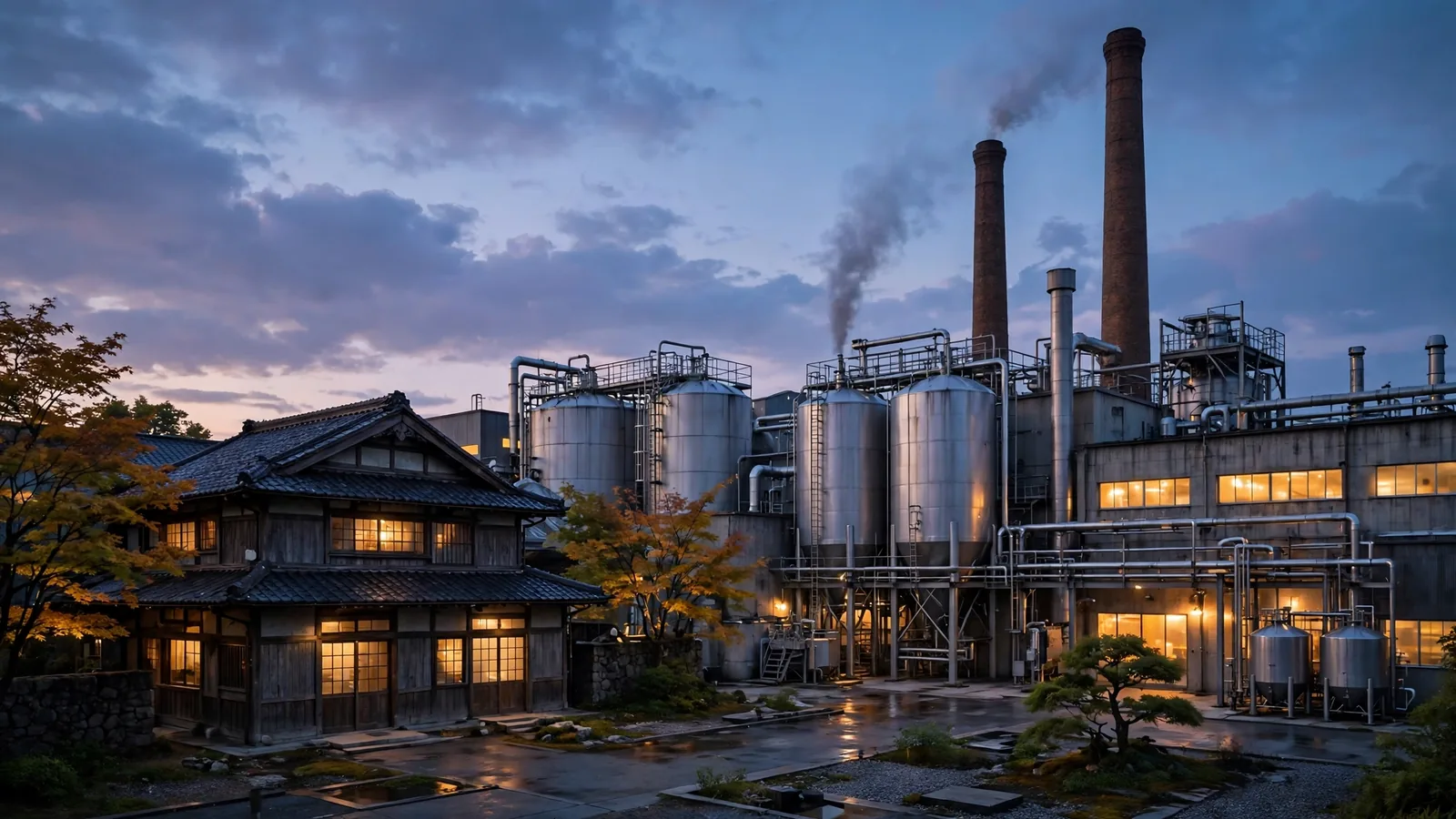
Japan: Asahi Ransomware — Beer, Fax Machines & 30 Factories
On 29 September 2025, Japan's largest brewer was stopped by ransomware. Asahi Group Holdings — about 40 percent of Japan's domestic beer market, 30 factories — found its administrative systems encrypted and its orders suspended. For weeks, staff took orders by phone and fax, wrote them by hand, and walked them to customers' offices. Convenience chains warned of cancelled shipments, restaurants ran out of Asahi Super Dry, and distributors received 10 to 20 percent of their usual deliveries. This is the story of how a modern food company was reduced to paper, and what it cost.
In short
Attribution: Claimed — Qilin ransomware group (Russia-linked, per secondary reporting; ransomware-as-a-service, active since 2022). No state attribution. Ransomware was detected on 29 September 2025 at 07:00 Japan Standard Time, when data centres were quarantined and servers and PCs were encrypted the same day. The attacker had gained access via network equipment at an internal Group site, with a dwell time of about six weeks as reported (not company-confirmed). All administrative systems in Japan were suspended; order receipt and dispatch were suspended and switched to manual operation — phone, fax, handwritten orders, staff walking to customer offices. Production halted at all 30 factories; 6 breweries partially restarted on 2 October 2025 and soft-drink factories partially resumed on 8-9 October. Direct impact was JPY 5 billion (about $31.4 million) in lost revenue and JPY 2 billion (about $12.6 million) in lost profit, per the company in March 2026. Personal data of about 1.9 million individuals was potentially exposed, with 115,513 instances confirmed as of 18 February 2026 in the company's February 2026 presentation — two different measures, stated separately. Qilin leaked 27 GB. Orders via the Electronic Ordering System resumed in December 2025 and logistics were normalising in February 2026. The CEO said Asahi would not pay a ransom.
What happened on 29 September 2025
Attribution: Claimed — Qilin ransomware group. The attack was detected on 29 September 2025 at 07:00 Japan Standard Time. Data centres were quarantined the same day, and ransomware encrypted servers and PCs across the company's Japanese operations. The attacker had gained access through network equipment at an internal Group site, and the dwell time was reported as about six weeks — a figure from secondary timelines, not confirmed by the company, and stated here as reported. All administrative systems in Japan were suspended. Order receipt and dispatch were suspended. Production halted at all 30 factories.
The scale is what makes this case stand out in the food-supply story. Asahi is Japan's largest brewer, with about 40 percent of the domestic beer market. Thirty factories stopped at once. That is not a single plant going down; it is the production base of a national food and drink company, encrypted in a morning. The company's response was to fall back on the oldest tools available: phone calls, fax machines, handwritten orders, and staff walking to customer offices to take orders in person. It worked, after a fashion. It also showed how thin the margin is between a modern supply chain and a paper one.
Beer by fax: the manual weeks
For weeks, Asahi ran on manual operation. Orders came by phone and fax, were written by hand, and were carried to customers by staff on foot. Six breweries partially restarted on 2 October 2025, three days after the attack. Soft-drink factories partially resumed on 8-9 October. But the flow of goods stayed far below normal: distributors received 10-20 percent of their usual shipments, convenience chains 7-Eleven, Lawson and FamilyMart warned of or cancelled shipments, and restaurants ran out of Asahi Super Dry — the brand that defines the company's beer business. The Electronic Ordering System, the channel through which modern orders normally flow, did not resume until December 2025, and logistics were still normalising in February 2026.
The manual weeks are the most instructive part of this case for preparedness planning. Asahi's staff knew how to take an order by phone and write it down. Many companies do not retain that knowledge, because their staff have never worked without the system. The Netherlands' Phase Black planning assumes that emergency supermarkets will operate with generators and analogue processes when digital systems fail — the same fallback Asahi was forced into. The difference is that Asahi improvised it under attack, while the Dutch plan is trying to prepare it in advance. The lesson is that a manual fallback is not a plan unless it has been practised, and Asahi's experience shows both that it can work and how much it costs in speed and volume.
What it cost
Attribution: Company figures, March 2026. The direct impact, per the company in March 2026, was JPY 5 billion (about $31.4 million) in lost revenue and JPY 2 billion (about $12.6 million) in lost profit. Those are the company's own figures, and they cover the direct impact only — they do not include the cost of recovery, the cost of the manual operation, or the longer-term damage to customer relationships. The full-year results were delayed, which is itself a measure of how deeply the attack disrupted the company's administration.
The data figures need the same care as the financial ones. Personal data of about 1.9 million individuals was potentially exposed, and 115,513 instances were confirmed as of 18 February 2026 in the company's February 2026 presentation. Those two numbers measure different things at different dates — potential exposure versus confirmed instances — and they must not be conflated into a single figure. Qilin leaked 27 GB of data. The CEO said Asahi would not pay a ransom, and no payment was reported. The company's February 2026 business update presentation is the primary source for the recovery timeline and the confirmed data figures.
Qilin and the food sector
Attribution: Claimed — Qilin, a ransomware-as-a-service operation active since 2022, described as Russia-linked in secondary reporting. Qilin claimed responsibility for the Asahi attack. No state attribution has been made. Qilin matters beyond this one case because it was the most active ransomware group in the food and agriculture sector in 2025, according to Food & Ag-ISAC figures reported in March 2026 — 265 ransomware attacks on food and agriculture in 2025, with 72 active threat actors, 59.3 percent Russian-linked and 25.4 percent Chinese-linked. Those are industry figures, not government statistics, and they are stated here as such.
The food sector is attractive to ransomware groups for the same reason healthcare is: the product is perishable, the supply chain is time-critical, and the pressure to restore operations is immediate. A brewery that cannot ship beer loses revenue every day, and a food distributor that cannot receive or dispatch goods has stock spoiling in warehouses. Asahi's case is the largest food-sector ransomware incident in this hub by production impact — 30 factories — and it is the clearest illustration of the food-supply ransomware timeline that runs from JBS in 2021 through Dole in 2023 to Asahi in 2025 and Ahold Delhaize in 2026. That timeline has its own page in this hub.
The Dutch connection: Ahold Delhaize and the autumn of 2026
Asahi is a Japanese case, but its relevance to the Netherlands is direct. The Ahold Delhaize incident of October 2026 — the trigger for the Phase Black plan — had the same shape: a food company whose distribution and ordering systems stopped, whose shelves emptied within days, and whose recovery took weeks. Asahi's shelves emptied because its factories stopped; Albert Heijn's shelves emptied because its distribution centres stopped. The mechanism differs, the result is the same, and the two cases together are the evidence base for the argument that food supply is now a cyber-security issue, not only a logistics issue.
There is also a smaller, unverified Japanese connection that this page does NOT present as fact. A few days before the Ahold incident, ransomware at a Japanese cloud provider was reported to have left frozen-food warehouse company Nissui Logistics — 17 cold-storage and distribution centres — unable to receive or ship goods, with all 17 locations reported back to normal operations by 20 October 2026. The only source found for that item was a single secondary account, and it is treated here as a lead only: it is noted on the food-supply timeline page as DEVELOPING, not published as a verified incident. It is mentioned here so readers who have seen the claim know why it does not appear as a fact on this page.
What Asahi changed
Asahi's recovery was slow and public. Orders through the Electronic Ordering System resumed in December 2025, two months after the attack. Logistics were normalising in February 2026, four months after. The full-year results were delayed. The company's February 2026 presentation gave the confirmed data figures and the recovery status, and it is the most authoritative account of the incident's aftermath. What the company changed internally — its network architecture, its access controls, its backup and recovery procedures — has not been published in the detail that would let this page describe it, and this page does not speculate.
The wider change is in the food sector's awareness. Before Asahi, food-sector ransomware was associated with JBS in 2021 and Dole in 2023 — large cases, but ones that could be treated as exceptional. After Asahi, and after the autumn 2026 supermarket attacks in Europe, the pattern is harder to dismiss: food production and distribution are being attacked repeatedly, by different groups, in different countries, with the same result — empty shelves and manual workarounds. That is the context in which the Netherlands began planning emergency supermarkets, and it is why this Japanese case sits in a hub about European preparedness.
Frequently asked questions
Detected 29 September 2025 at 07:00 Japan Standard Time. Production halted at all 30 factories the same day, and orders were suspended.
Manually — by phone and fax, with handwritten orders, and staff walking to customer offices. The Electronic Ordering System did not resume until December 2025.
JPY 5 billion (about $31.4 million) in lost revenue and JPY 2 billion (about $12.6 million) in lost profit, per the company in March 2026. Full-year results were delayed.
About 1.9 million individuals were potentially exposed, and 115,513 instances were confirmed as of 18 February 2026. The two figures measure different things and are stated separately. Qilin leaked 27 GB.
The Qilin ransomware group claimed responsibility. Qilin is a ransomware-as-a-service operation active since 2022, described as Russia-linked in secondary reporting. No state attribution has been made.
Six breweries partially restarted 2 October 2025, soft-drink factories partially resumed 8-9 October, orders via the Electronic Ordering System resumed in December 2025, and logistics were normalising in February 2026.
Both show food supply failing when digital systems fail. Asahi's factories stopped; Ahold Delhaize's distribution stopped in October 2026. Together they are the evidence that food supply is now a cyber-security issue, which is why the Netherlands is planning emergency supermarkets.
Figures are given with their snapshot time and source. Developing items are marked as developing. Last checked Tuesday 17 November 2026, about 12:50 PKT.