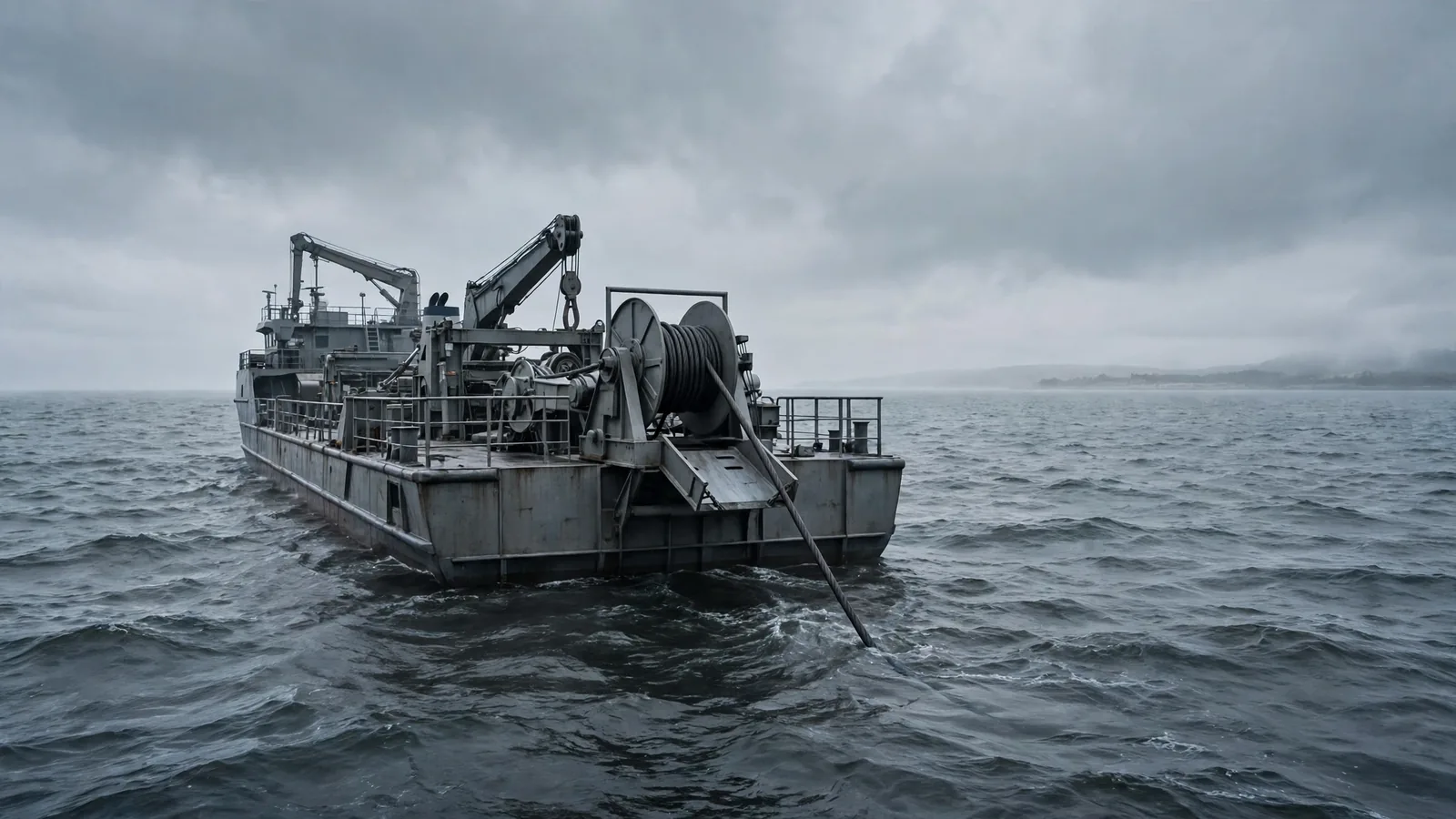
Baltic Sea: Undersea Cable Sabotage — Fitburg & Eagle S
In the winter of 2024-2025, undersea cables in the Baltic Sea were cut — not by hackers, but by ships dragging their anchors across the seabed. The cases that followed produced the first court conviction for deliberate Baltic cable sabotage, on 5 November 2026, and a dismissal on jurisdiction in the best-known case of all. These incidents are not cyberattacks, and this page labels them as such. They are included in this hub because readers keep asking whether the cable cuts were cyberattacks, and because they belong to the same story: the physical infrastructure that carries Europe's internet, power and data is as exposed as its digital systems.
In short
Attribution: Court finding (Fitburg) — deliberate conduct found by Helsinki District Court, 5 November 2026; NOT a cyberattack — physical anchor-dragging. Fitburg: on 31 December 2025 a cargo vessel dragged anchor and chain about 130 km across the seabed in the Gulf of Finland, crossing 9 telecom and electricity cables and 1 gas pipeline, damaging two telecommunications cables (Elisa, Arelion) and endangering 7 others plus a gas pipeline. The vessel was seized the same day. On 5 November 2026 the Helsinki District Court found captain Andrei Maksimenko (Russian) and boatswain Vusal Majidov (Azerbaijani) guilty of aggravated criminal damage / aggravated sabotage (wording differs by outlet), sentencing them to 3 years 6 months and 2 years 10 months. Both denied wrongdoing; the judgment is not final and is subject to appeal. The court found the conduct intentional; it did NOT establish that Maksimenko personally ordered the anchor lowered. Eagle S: on 25 December 2024 five cables broke including the Estlink-2 electricity link between Finland and Estonia. Finnish prosecutors charged the captain and two officers with aggravated sabotage in August 2025, alleging about 90 km of anchor drag. The Helsinki District Court dismissed the case on 3 October 2025 for lack of jurisdiction, as the damage was outside Finnish territorial waters; the deputy prosecutor general said he would appeal, and as of 7 November 2026 no Court of Appeal ruling had been found. NO court has found the Eagle S incident was sabotage.
NOT a cyberattack — read this first
Attribution: Court finding for Fitburg; no court finding for Eagle S. Neither incident is a cyberattack. No computer system was hacked, no network was breached, and no malware was involved. The damage was done by steel: an anchor and chain dragged across the seabed, cutting or damaging the cables that lie on it. This page is in a cyberattacks hub because the question 'were the Baltic cables cut by hackers?' is asked constantly, and the answer matters: treating a physical sabotage as a cyberattack misdirects the response, the investigation and the defences. The defence against anchor-dragging is maritime surveillance, anchor monitoring and legal accountability — not firewalls.
The distinction also matters for attribution. A cyberattack is attributed through forensic analysis of infrastructure, tooling and code. An anchor-dragging case is decided in court, on evidence about a ship's movements, its anchor, its crew and its orders. The Fitburg case was decided that way, and the Eagle S case was dismissed that way. The legal outcomes are the facts; everything else is commentary. This page reports the court outcomes and the charges, and does not go beyond them.
Fitburg: the conviction of 5 November 2026
Attribution: Court finding — deliberate conduct; judgment not final, subject to appeal. The cargo vessel Fitburg departed St Petersburg on 30 December 2025, bound for Haifa, flying the flag of Saint Vincent and the Grenadines. On 31 December 2025 it dragged its anchor and chain about 130 km across the seabed in the Gulf of Finland, crossing 9 telecommunications and electricity cables and 1 gas pipeline. Two undersea telecommunications cables — belonging to Elisa and Arelion — were damaged, and 7 other cables plus a gas pipeline were endangered. The vessel was seized the same day.
On 5 November 2026, the Helsinki District Court found captain Andrei Maksimenko, a Russian national, and boatswain Vusal Majidov, an Azerbaijani national, guilty of aggravated criminal damage / aggravated sabotage — the wording differs by outlet. Maksimenko was sentenced to 3 years 6 months and Majidov to 2 years 10 months. Both denied wrongdoing, and the judgment is not final: it is subject to appeal. The court found the conduct intentional, which makes this the first Baltic cable case in which a court has found the act was deliberate. But the court did NOT establish that Maksimenko personally ordered the anchor to be lowered — a narrower finding than some reporting suggests, and one this page states precisely.
Eagle S: the case that was dismissed
Attribution: No court finding of sabotage. On 25 December 2024, five cables broke in the Baltic Sea, including the Estlink-2 electricity link between Finland and Estonia. The tanker Eagle S was suspected: prosecutors alleged it had dragged its anchor about 90 km across the seabed. In August 2025, Finnish prosecutors charged the captain and two officers with aggravated sabotage and aggravated interference with telecommunications. On 3 October 2025, the Helsinki District Court dismissed the case for lack of jurisdiction, because the damage was outside Finnish territorial waters. The deputy prosecutor general said he would appeal, and as of 7 November 2026 no Court of Appeal ruling had been found in the sources checked.
The Eagle S outcome is the opposite of Fitburg's, and the difference is instructive. In Fitburg, the court reached the substance and found deliberate conduct. In Eagle S, the court never reached the substance, because it held it had no jurisdiction over damage outside Finnish waters. That means NO court has found that the Eagle S incident was sabotage. The vessel was suspected, the crew were charged, and the case was dismissed on a jurisdictional ground. Readers who describe Eagle S as a proven sabotage are wrong, and this page does not repeat the error. The appeal, if it proceeds, may change the position; until it does, the position is as stated here.
The wider pattern: November 2024 and Baltic Sentry
The Fitburg and Eagle S cases did not happen in isolation. On 17-18 November 2024, cables between Finland and Germany and between Sweden and Lithuania were cut. German Defence Minister Boris Pistorius said Germany had to assume sabotage, while noting the lack of certain information — a careful formulation that acknowledged suspicion without claiming proof. In January 2025, NATO launched Operation Baltic Sentry, a mission to protect undersea infrastructure in the Baltic Sea with patrols, surveillance and rapid response.
The context for all of this is a statistical fact that is often lost in the coverage: according to TeleGeography, about two-thirds of cable faults are accidents, and deliberate sabotage is exceedingly rare. Most cable damage is caused by fishing gear and anchors dragged by accident, not by design. That does not make the Fitburg conviction less significant — a court found deliberate conduct, which is precisely what makes it exceptional — but it does mean that every cable cut should not be assumed to be sabotage. The burden of proof is on the evidence, and in the Baltic the evidence has produced one conviction, one dismissal, and a great deal of unresolved suspicion.
Why cables matter to preparedness
Undersea cables carry the overwhelming majority of international internet traffic, and the Baltic cables carry power as well as data — Estlink-2 is an electricity link between Finland and Estonia. Cutting them does not just slow the internet. It can cut power between countries, disrupt financial transactions, and isolate a region. That is why NATO treats Baltic undersea infrastructure as a security issue, and why the Netherlands' preparedness planning — which assumes that digital systems may fail — has a physical counterpart in the protection of cables, pipelines and ports.
The connection to the cyberattacks in this hub is indirect but real. The same actors who attack digital systems have an interest in physical infrastructure, and the same governments that must defend networks must also defend cables. But the defences are different. A cable is defended by watching the ships above it, by monitoring anchors, and by having repair ships ready. A network is defended by patching, segmentation and authentication. Confusing the two — treating a cable cut as a hack, or a hack as a cable cut — leads to the wrong defences being bought. This page exists to keep the distinction visible.
There is one more reason these cases sit in this hub. The Baltic Sea is one of the most closely watched stretches of water in the world since 2024, and every new cable fault is now reported as a possible attack. That scrutiny is justified by the Fitburg conviction, and it is also a risk: constant suspicion without court findings can turn every accident into an international incident. The record as of 17 November 2026 is one conviction, one dismissal on jurisdiction, and several unresolved cuts. That is the record this page reports, and it is the record against which any future incident should be judged.
What is still unknown
Attribution: Fitburg — court finding, judgment not final, subject to appeal. Eagle S — no court finding; appeal pending as of 7 November 2026. Whether the Fitburg judgment will survive appeal is unknown. Whether the Eagle S appeal will succeed is unknown. Whether the November 2024 cable cuts were sabotage or accident has not been established by a court. NATO's Operation Baltic Sentry continues, and further incidents — accidental or deliberate — are likely in a sea crossed by so much shipping. This page will be updated if a court rules on either appeal, and any update will be dated.
Frequently asked questions
No. They were physical anchor-dragging incidents — ships dragging anchors across the seabed and cutting cables. No computer system was hacked and no malware was involved.
On 31 December 2025 the cargo vessel Fitburg dragged its anchor about 130 km across the Gulf of Finland, damaging two telecom cables and endangering 7 others plus a gas pipeline. On 5 November 2026 a Helsinki court found the captain and boatswain guilty of aggravated criminal damage / sabotage and sentenced them to 3 years 6 months and 2 years 10 months.
No. Both men denied wrongdoing and the judgment is not final — it is subject to appeal. The court found the conduct intentional but did not establish that the captain personally ordered the anchor lowered.
On 25 December 2024 five cables broke including the Estlink-2 power link. The captain and two officers were charged with aggravated sabotage in August 2025, but the Helsinki District Court dismissed the case on 3 October 2025 for lack of jurisdiction. No court has found it was sabotage.
Exceedingly rare, according to TeleGeography: about two-thirds of cable faults are accidents, mostly fishing gear and anchors dragged by accident. The Fitburg conviction is significant precisely because a court found deliberate conduct.
A NATO mission launched in January 2025 to protect undersea infrastructure in the Baltic Sea, with patrols, surveillance and rapid response, following the cable cuts of November-December 2024.
They carry most international internet traffic, and some — like Estlink-2 between Finland and Estonia — carry electricity too. Cutting them can disrupt data, power and financial transactions between countries.
Figures are given with their snapshot time and source. Developing items are marked as developing. Last checked Tuesday 17 November 2026, about 12:50 PKT.